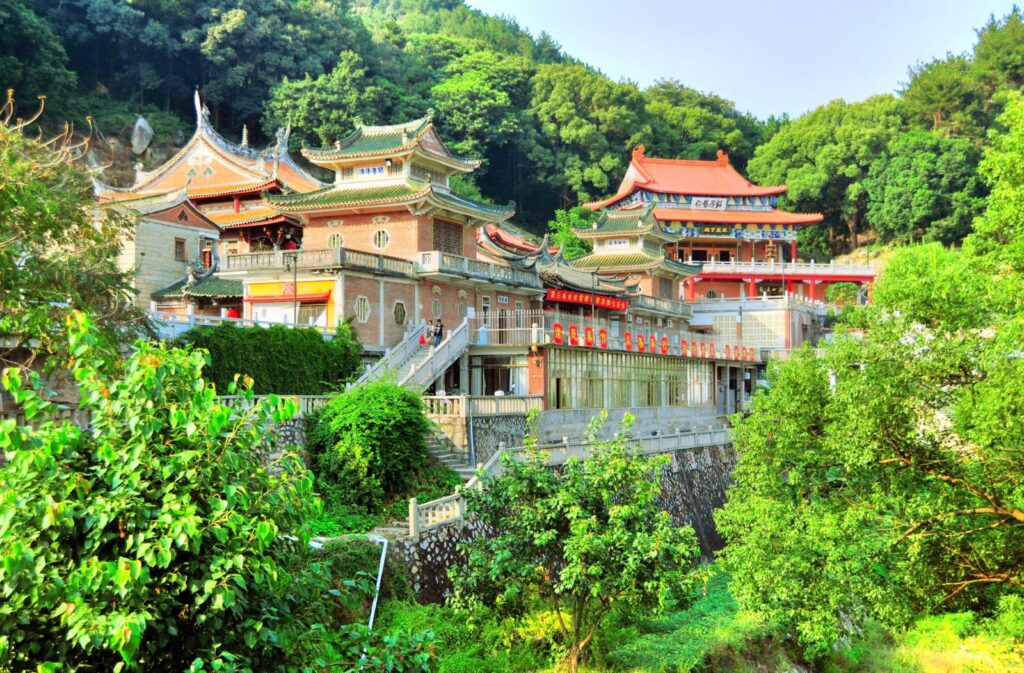
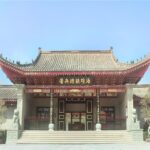
Zhiti Temple was built in 971 AD for Qian Chu, King of Wuyue. The temple houses rare treasures including the iron Buddhist statues of “Thousand Saints Heavenly Crown” bestowed during the Yongle and Wanli reigns of the Ming Dynasty, the gilded copper statue of “Great Vairocana Buddha”, the purple robe with five-clawed golden dragons, and the “Northern Tripitaka”. Since the Ming Dynasty, this place has been revered as a “Fairy Nest and Buddha Grotto”. In April 1983, it was listed by the State Council as one of the key Buddhist temples in China.
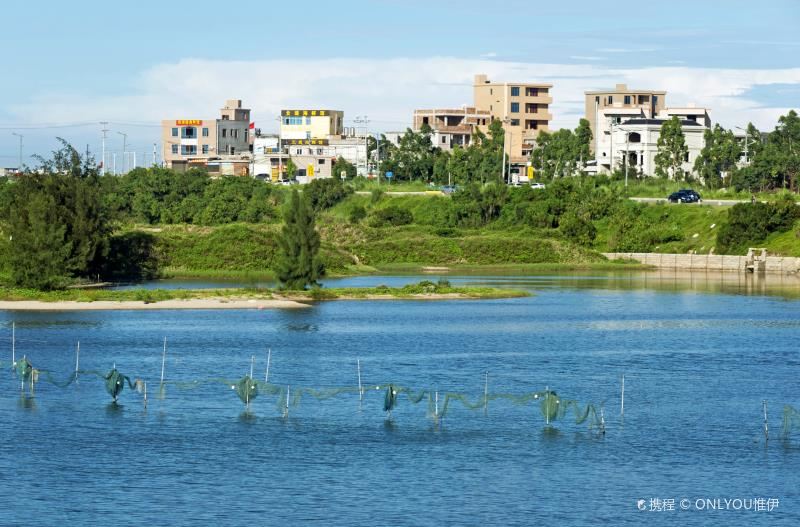
Juzhou Village in Hongkou Township, located at the foot of Zhiti Mountain, was known as “Yingzhou” in ancient times. A stream stretching 20 kilometers flows from here to Huotong Town. The stream features nine bends and thirty rapids. Along its banks are scenic spots such as “Horse Turning Back to Court”, “Golden Bell Covering the Ground”, “Half-Rolled Pearl Curtain”, “Bride Alighting from Sedan”, “Floating Dragon Pearl”, “Yuxi Holy Well”, “Double Rainbow Drinking from Cave”, and “Yellow Bee Emerging from Cave”. Boating along the stream passes through many rushing torrents, which is quite thrilling, hence the name “Yingzhou Oars Against the Current”.
Related posts:
 Shuanglongtan Ecological Sports Scenic Area – Xianxi District, Xiamen
 Shuzhuang Garden: A Fusion of Minnan and Western Architecture
 Shuzhuang Garden: A Blend of Fujian and Western Architectural Styles
 Fuzhou Minjiang River Night Cruise – A Glimpse of the Pearl of Chinese City Night Scenes
 Haitan Town General’s Office: A Private Museum of Coastal Defense Culture in Pingtan
 Xiamen Botanical Garden: A Haven for Rare Plants and Scenic Beauty