The Mountain Resort was built in 1703. It took 89 years to complete through the reigns of Kangxi, Yongzheng, and Qianlong of the Qing Dynasty. It was a meeting place for the Qing government with foreign envoys and ethnic minorities in border areas. It was also the second political center of the Qing Dynasty besides Beijing. It reflects the’soft’ side of the Qing government’s foreign policy. Foreign envoys can communicate with the Qing government without a long journey to Beijing. The complex political purposes are turned into harmony in the secluded garden. The resort is divided into four major areas. The south is the palace area and lake area. The north is the mountain area and plain area. Among them, the palace area and lake area are the essence of the Mountain Resort.
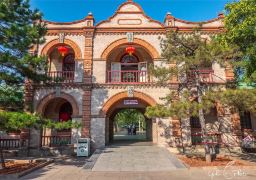
Palace Area: As soon as you enter through the main entrance of the Mountain Resort (located on Lizhengmen Street), you can see the palace area. So generally, people visit the palace area first. Since the Mountain Resort was a place for the Qing government to meet with foreigners, it was built with the etiquette for receiving foreign guests. Therefore, the specification is extremely high, equivalent to that of the Forbidden City. At the same time, in order to show the traditional virtues of modesty and frugality of the Chinese nation in front of foreign guests, the palace area appears simple and generous in overall layout. However, the building materials are very precious. The main hall, Danbo Jingcheng Hall, is entirely made of nanmu wood. It is a standard ‘low-key luxury’. The design can be said to be ‘elaborate’. Enter through the door with the plaque of ‘Mountain Resort Museum’. The tour of the palace area begins. See in turn the Yueshe Gate with the four characters plaque of ‘Mountain Resort’ written by Emperor Kangxi, the main hall Danbo Jingcheng Hall, and the Yanbo Zhishuang Hall where Emperor Jiaqing and Emperor Xianfeng died. It takes about two hours to tour the palace area. Exit through the back door, go down a slope, and you will reach the boarding point for the mountain sightseeing bus to visit the mountain area. Mountain Area: If there is enough time, after touring the palace area, take the mountain sightseeing bus to tour the mountain area. If time is limited, you can give up the mountain area and go directly to the lake area. The mountain area accounts for four-fifths of the area of the Mountain Resort. Wealthy families build gardens and decorate with several small rockeries. It is unheard of to enclose vast mountains. The profound meaning of Emperor Kangxi when building the Mountain Resort is probably to remind future generations not to forget that their nation comes from far beyond the mountains, and also not to forget the foreign ethnic groups eyeing their territory beyond the mountains. Along the way on the mountain sightseeing bus, you will pass many scenic spots, but you can only look at them from the bus. Only three stops, ‘Simi Yunshan’, ‘Erma Dao’, and ‘Qingfeng Luyu’, will let tourists get off and visit. Among the three stops, ‘Erma Dao’ is more interesting. Standing on the wall of the Mountain Resort, you can see the Potala-like Temple (commonly known as ‘Little Potala Palace’) and Puning Temple among the Eight Outer Temples (religious sites built for ethnic minorities meeting with the Qing Dynasty). The golden roof of the Little Potala Palace shines brightly in the sun, especially conspicuous.When the mountain-circling vehicle arrives at ‘Fangyuan Residence’, that is the terminus. Fangyuan Residence is located on the west bank of Ruyi Lake. After getting off, you can directly visit the lake area.
Lake Area: The reason why there are pavilions on the lake surface like the Mountain Resort in the north is due to the love of emperors Kangxi and Qianlong for the scenery of the south of the Yangtze River. Although the lake area imitates the characteristics of the combination of architecture and water in the south of the Yangtze River, it is much grander than the small bridges and flowing water in the south of the Yangtze River. The Mountain Resort has a total of ’72 scenic spots of Kangxi and Qianlong’ – 36 scenic spots inscribed by Kangxi and 36 scenic spots inscribed by Qianlong. It is actually not very possible to collect all 72 scenic spots. Some scenic spots are very small and may be missed if you don’t pay attention while walking. Among the 72 scenic spots, 31 are in the lake area. Visiting the lake area is equivalent to visiting the ‘condensed version’ of the 72 scenic spots. Among them, the Misty Rain Tower is a must-visit. It is built by imitating the Misty Rain Tower on Nanhu Lake in Jiaxing and is one of the shooting locations of the TV drama ‘Princess Pearl’. In the lake area, you can also take a pedal boat and go boating on the lake. The reference price is 50 yuan per hour. Plain Area: Located between the mountain area and the lake area. Walk north along the east side of the Mountain Resort from the lake area to reach it. The western part of the plain area is grassland, with the horse trial field where the emperor held horse racing activities as the main body; the eastern part is woodland, called Wanshu Garden, in which there are 28 yurts of different specifications. In the plain area, there is also Wenjin Pavilion, the royal library where the Complete Library in Four Branches was once stored, Yongyou Temple, Chunhao Pavilion, Suyun Eaves and other buildings. If you are particularly interested in and have some research on the history of the Qing Dynasty, the numerous stone inscriptions in the Mountain Resort are worthy of careful appreciation. The builders of the Mountain Resort would not have thought that this place would become a tourist attraction a hundred years later. There are certainly some pedantic expressions on the stone inscriptions, but more are intimate words for their own family. For example, Qianlong successively composed six poems on the same stone tablet in Songyun Gorge to express his wish to be a carefree wild crane after achieving success. After his son Jiaqing read it, he could only silently express on the nearby stone inscription: Father’s poems are really profound, and I feel a great pressure (Contemplating the inscription contains profound essence, and guarding the throne is a heavy responsibility)! Around the Mountain Resort, there are the Potala Palace-like Temple (commonly known as ‘Little Potala Palace’), Puning Temple, and Panhammer Peak Scenic Area, which can be visited together. There are few places to eat inside the Mountain Resort. It is recommended that tourists who plan to visit for a long time and like to take their time bring some dry food. However, there are many characteristic catering shops outside the Mountain Resort. After leaving the Mountain Resort, you can taste the characteristic dishes of Chengde, including mutton soup, baked cake, fresh flower rose cake, Nansha cake, imperial lotus leaf chicken, etc. Opening hours: Open from 07:30 to 17:30 from April 1 to April 30; open from 07:00 to 18:00 from May 1 to October 9; open from 08:00 to 17:30 from October 10 to March 31. Preferential policies: Children: Children under 6 years old (inclusive) or with a height of 1.Children under 2 meters (including) must be accompanied by a guardian to enter the scenic area for free. Minors: From 6 years old (excluding) to 18 years old (including) can enjoy half-price tickets with valid ID cards or student certificates. Students: Full-time undergraduate and below students can enjoy half-price tickets with student certificates. Elderly: People aged 70 and above can enter for free with valid ID cards, passports, or Hong Kong, Macao, and Taiwan travel permits; those aged 60 to 69 can enjoy half-price tickets with valid ID cards. Elderly with Beijing or Tianjin household registration aged 60 and above can enter for free with ID cards. Retired cadres: Can enter for free with retirement certificates. Active-duty military personnel (armed police): Can enter for free with officer certificates, civilian cadre certificates, non-commissioned officer certificates, conscript certificates, student certificates, or retired (retired) military certificates. Firefighters: National comprehensive fire and rescue team retirees, cadres, disabled personnel, firefighters, and students can enter for free with valid certificates. Disabled people: Can enter for free with disability certificates issued by the China Disabled Persons’ Federation and valid ID cards. First and second-degree severely disabled individuals in terms of physical, visual, intellectual, or mental disabilities are allowed to bring one accompanying person for free. Disabled soldiers/surviving families, etc.: Disabled soldiers with certificates from the People’s Republic of China, disabled civil servants with certificates from the People’s Republic of China, veterans from Hebei Province with preferential treatment certificates, surviving families of martyrs from Hebei Province with preferential treatment certificates, surviving families of soldiers who died in public service from Hebei Province with preferential treatment certificates, and surviving families of deceased soldiers from Hebei Province with preferential treatment certificates, can enter for free. Hebei Province’s Yan Zhao Elites: Can enter for free with Hebei Province’s Yan Zhao Elite Service A or B cards (A card is valid within Hebei Province, B card is valid within Chengde City). Medical workers: On International Nurses’ Day (May 12) and Doctor’s Day (August 19), medical workers with medical or nursing practice certificates, awards, or professional titles can enjoy free tickets. Journalists: Can enter for free with press cards issued by the National Press and Publication Administration. Tour group guides: Can enter for free with tour guide certificates issued by the National Tourism Administration and tour group task orders. Hebei Province’s unpaid blood donors: Can enter for free with Hebei Province’s unpaid blood donation honor cards. Chengde City-level and above labor models, outstanding experts, and top talents: Can enter for free with valid certificates issued by the provincial and municipal people’s governments. Tourism law enforcement and price law enforcement, national security law enforcement personnel: Can enter for free with law enforcement certificates (must be two or more people with a law enforcement notice). Hebei Province’s retired military personnel: Can enter for free with preferential treatment certificates. Disabled people’s police: Can enter for free with certificates from the People’s Republic of China. Service facilities Parking lot: [Chengde Summer Resort Parking Lot] Reference price: ¥20/visit; Address: No. 20 Lizhengmen Road, Shuangqiao District, Chengde City, Hebei Province; Spaces: 200. WIFI: Account: CDBSSZ; Password: Please verify and log in according to the page prompts; Coverage: Full coverage of the scenic area. Transportation within the park: Reference price: Paid. Restrooms: There are restrooms in the scenic area, located near Dehui Gate, Yuese Jiangsheng, Yanyu Building, Wenzheng Pavilion, Mongolian Yurt, Chunhao Pavilion, Wanshu Garden, Songhe Studio, etc. , with clear signs.