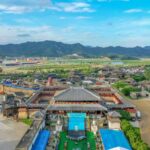
Mishan Island, a small oasis of tranquility within the vast Thousand Islands Lake, spans an area of just 0.36 square kilometers. It’s a place steeped in Zen, offering a serene retreat for visitors seeking a touch of peace.

At the island’s summit stands the Mishan Zen Temple, a spiritual beacon that has guided the faithful for centuries. Legend has it that at the base of the mountain once stood a Mashi Temple, where an abbot named Mi, a monk of great reverence, banished a malevolent dragon from the East China Sea. In his honor, during the Kaibao era of the Northern Song Dynasty, the Mishan Zen Temple was erected atop the mountain, and the mountain itself was named after this holy man, becoming Mishan. Since that time, the temple’s incense has been a constant, and the mountain has borne his name.
Within the island’s scenic area, one can find the sacred ‘Washing Bowl Pond,’ more commonly known as the ‘Divine Well.’ The water drawn from this well is referred to as the ‘Divine Spring.’ It is said that the tale of the three monks without water has its origins in this very spot.
The island also houses the stupas of the three monks, situated close to the Wangbo Pavilion on the hillside. These stupas, standing at approximately 3 meters in height and fashioned in a hexagonal shape from six rectangular tuff stones—also known as tea garden stones—exude a sense of simplicity and unpretentious elegance. Beside the stupas, there are two tombs, and the inscriptions on them reveal that the deceased were in a direct master-apprentice relationship, dating back to the mid-Qing Dynasty.
Mishan Island is open to visitors all year round, with access available around the clock, offering a constant opportunity to immerse oneself in its spiritual and natural beauty.