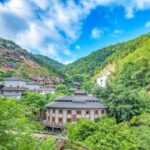
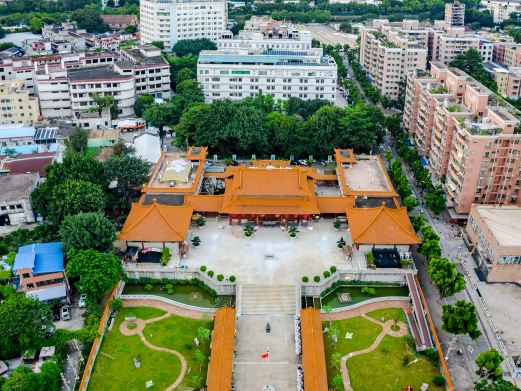
Dalu Village Folk Custom Tourism Area is renowned for its grand ancient residential architecture, centuries-old couplet culture, and local specialties such as the ‘March Red’ lychee and ‘Dalu’ ponkan, earning it the nickname ‘Lychee Village’. The ‘March Red’ lychee and ponkan produced in the village are celebrated for their fresh color, superior quality, and delicious taste, enjoying popularity in domestic and international fruit markets.
The ancient residential complex in Dalu Village, built during the Ming and Qing dynasties, covers an area of 42,000 square meters and consists of nine ancient buildings including Huo’er Building, Sanda Hall, Shuangqing Hall, Dongyuan Villa, and Lao’s Ancestral Hall. These buildings are characteristic of Lingnan residential architecture, emphasizing decoration with exquisite artistic embellishments on beams, brackets, eaves, walls, foundations, screens, and doors and windows. The carving techniques are superb, and the complex is well-preserved, with over ten plaques such as imperial edicts, congratulations, academic titles, and auspicious phrases still hanging in the hall and indoor areas, holding significant historical research value.
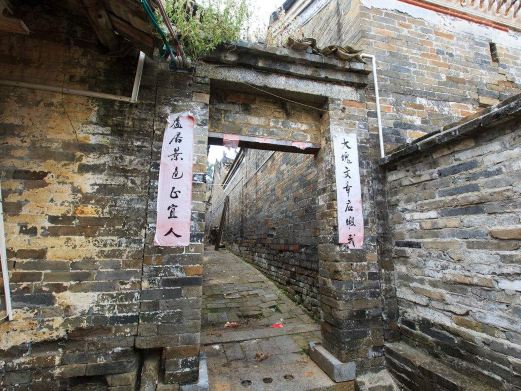
Inside the ancient residential complex, there are nearly a hundred couplets from the Ming and Qing dynasties and over 200 couplets created after the founding of the People’s Republic of China, showcasing a rich cultural connotation. The ancient residence, nestled against the mountains and waters, is quiet and profound, housing numerous cultural relics including the handwriting of Wen Tianxiang, witnessing the glory of history. Valuable are the more than 300 couplets created during the Ming and Qing dynasties, which hold precious research value for human history and appreciation.
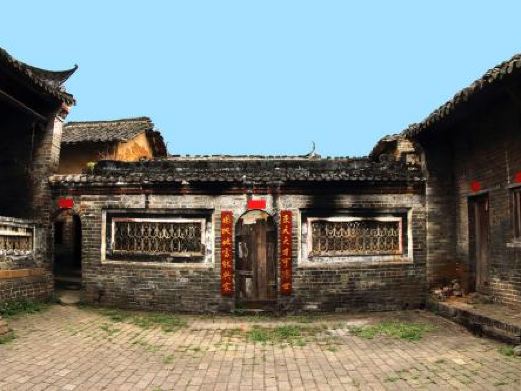
The Ming and Qing architectural complex, including Huo’er Building, Sanda Hall, Dongyuan Villa, Shuangqing Hall, Panlong Hall, Dongming Hall, Chen Zhuo Garden, Fuchun Garden, and Lao Kegong Ancestral Hall, is separated by artificial lakes, covering a total area of 220,000 square meters, with a protected area of 450,000 square meters. The sounds of chickens and dogs can be heard, and the ancient陛 trees, camphor trees, and lychee trees beside the houses and lakes symbolize ‘literary prominence and red-top status’, resembling giant bonsai, with winding paths leading to tranquility and harmony.
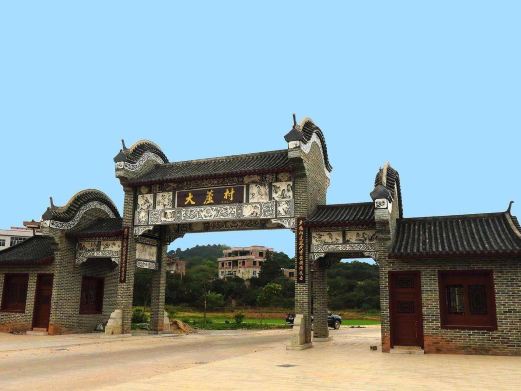
The ancient residential complex is vast, with comprehensive structure and function, high planning standards, a good ecological environment, and rich accumulation of folk culture. It preserves many cultural relics, retains some customs that vary from place to place, and is home to a group of folk musicians and dancers. In 1999, it was awarded the title of ‘Guangxi’s First Couplet Village’. Since its opening on National Day in 2000, Dalu Village’s folk custom tourism has attracted numerous visitors with its ancient, simple, unique, and special folk customs,接待国内外游客3万多人次. It is open all year round from 09:00 to 17:30.
Dalu Village Folk Custom Tourism Area
Dalu Village Folk Custom Tourism Area is renowned for its grand ancient residential architecture, ce[...]