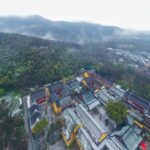
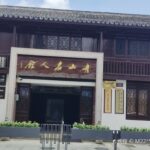
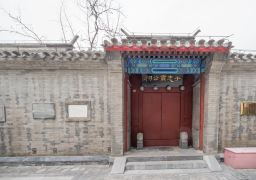
Ruan Gongci, situated at No. 60, Wu Mountain Yuanbaoxin, is dedicated to the worship of Ruan Yuan, a Qing Dynasty Zhejiang provincial governor. Born in 1764 and passing away in 1849, Ruan Yuan hailed from Yizhou, Jiangsu. He was a distinguished classicist and calligrapher of the Qing era, serving as a Grand Secretary of the Ti Ren Ge. Ruan Yuan held the roles of Zhejiang’s educational commissioner and provincial governor for many years, during which he undertook significant projects such as dredging West Lake, constructing sea dikes, and establishing academies, achieving notable political milestones. He is also known for his compilations, including ‘Thirteen Classics with Annotations and Explications’ and ‘Zhejiang and Jiangsu Epigraphy’.
The current structure of Ruan Gongci was reconstructed from Chongyang Temple during the fifth year of the Guangxu Emperor, covering an area of 320 square meters. The temple features a five-bay facade, a hard mountain structure, and is oriented from west to east. It spans a total width of 20 meters and a depth of 11 meters, built in the style of a six-bay front eave corridor using brick and wood materials. In 2007, Ruan Gongci underwent a renovation.
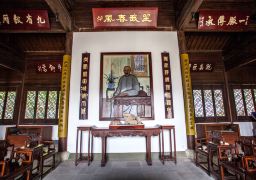
Today, after the renovation, Ruan Gongci presents a long stone staircase that leads directly to its entrance, exuding an imposing presence. The temple comprises side rooms, a main hall, and a transverse courtyard with a side hall. The main hall itself features a five-bay facade, a hard mountain structure, and is oriented from west to east, offering a bright and open space. Inside, the hall is arranged in the form of a central hall, with a large-scale line-engraved portrait of Ruan Yuan at the center, accompanied by a few display cases in front.The hall is a serene and elegant space, exuding an air of simplicity. The walls are lined with four antique-style silk paintings that capture Ruan Yuan’s significant contributions in Zhejiang and Hangzhou. His calligraphic works are also on display, adding a touch of cultural depth to the ambiance. Showcases throughout the hall present Ruan Yuan’s chronology, further calligraphic pieces, and various editions of his key writings. The tranquility and refinement of the setting are palpable. Please note that the opening hours and specific business status may vary depending on the daily conditions.