Duration: 1 day. Activity: Independent travel.
The author visited these places: Zhaojialou Ancient Town, Shanghai. Published on April 8, 2021, at 21:14.
On the morning of March 26, 2021, when the car passed the Wuzao Port Bridge on Ruipu Road in Pudong, Shanghai, I accidentally saw the Yongji Bridge at the east entrance of Shenzhuang Pond on the west side of Xiantang Port. I couldn’t help but think that I hadn’t been to this ancient stone bridge built in the eleventh year of Kangxi in the Qing Dynasty (1672 AD) and the old street of Shenzhuang where it is located for a long time, so I wanted to take time to walk around and have a look again.
Shenzhuang gradually became a village since the Yuan Dynasty. Shen Weisi (courtesy name Gongchang), the younger brother of Shen Wansan, the richest man in the south of the Yangtze River at the end of the Yuan Dynasty, once purchased a manor here. It was large in scale and quite famous, known as ‘Shen’s Farm’. Shenzhuang is named after it. During the Ming, Qing and Republican periods, Shenzhuang was clearly a water town market town on the west bank of Xiantang Port in Nanhui. After its splendor, it returned to plainness. After the middle of the last century, Shenzhuang gradually declined and became two ordinary villages belonging to different towns. Taking Shenzhuang Pond as the boundary river, to the north of the river is Shenxi Village, Zhoupu Town, Nanhui District of Shanghai, that is, Pudong. To the south of the river is Shenzhuang Village, Hangtou Town (Xiasha). The ancient style of the water town market town in the south of the Yangtze River is disappearing day by day. What can still be found as relics of Shenzhuang as a former water town market town are Shenzhuang Street running north-south along the west bank of Xiantang Port and Yongji Bridge spanning Shenzhuang Pond.
On an evening in January 2011, when I passed through Shenzhuang on my way from Zhaojialou Ancient Town in Pujiang, I deliberately visited. Due to the lack of protection and even being listed as a demolition area in recent years, this ancient water town by Xiantang Port has long lost its former scenery. Shenzhuang Street is fragmented and left to its own devices. The old buildings are disappearing, and the brick-paved pavement is also gradually wearing away.
On the evening of April 5, 2021, I walked into Shenzhuang again. After many years of absence, under the atmosphere of rumors of demolition and relocation, the situation of the disappearance of the style of the water town market town in Shenzhuang is even worse and has become dilapidated. Entering Shenzhuang Street through the winding alleys from Ruihe Road and walking straight north to Yongji Bridge. This single-arch stone arch bridge made of granite at the intersection of Shenzhuang Pond and Xiantang Port was funded and built by Zhang Bicheng. It has been nearly 349 years. Yongji Bridge is 35 meters long, with a span of 22 meters, a clear span of 7 meters, a width of 3.5 meters, and a height of 3.8 meters. There are 23 stone steps at both the north and south ends. The bridge opening is composed of 6 stone slabs horizontally and 7 stone slabs plus 6 sleeper stones longitudinally. The bridge name ‘Yongji Bridge’ is engraved on the beam stone of Yongji Bridge, and there are also auspicious cloud patterns engraved on both sides. The bridge couplets engraved on the north-south and east-west sides are all ‘Namo Amitabha’. As time passes by, it is difficult to appreciate the quiet and distant scenery of ‘Moonlit Night on Hongqiao Bridge’, one of the eight scenic spots of Hesha, where Yongji Bridge is located. The ancient town style of Shenzhuang has become fragments, and only a corner at the southeast end of Yongji Bridge can be seen.
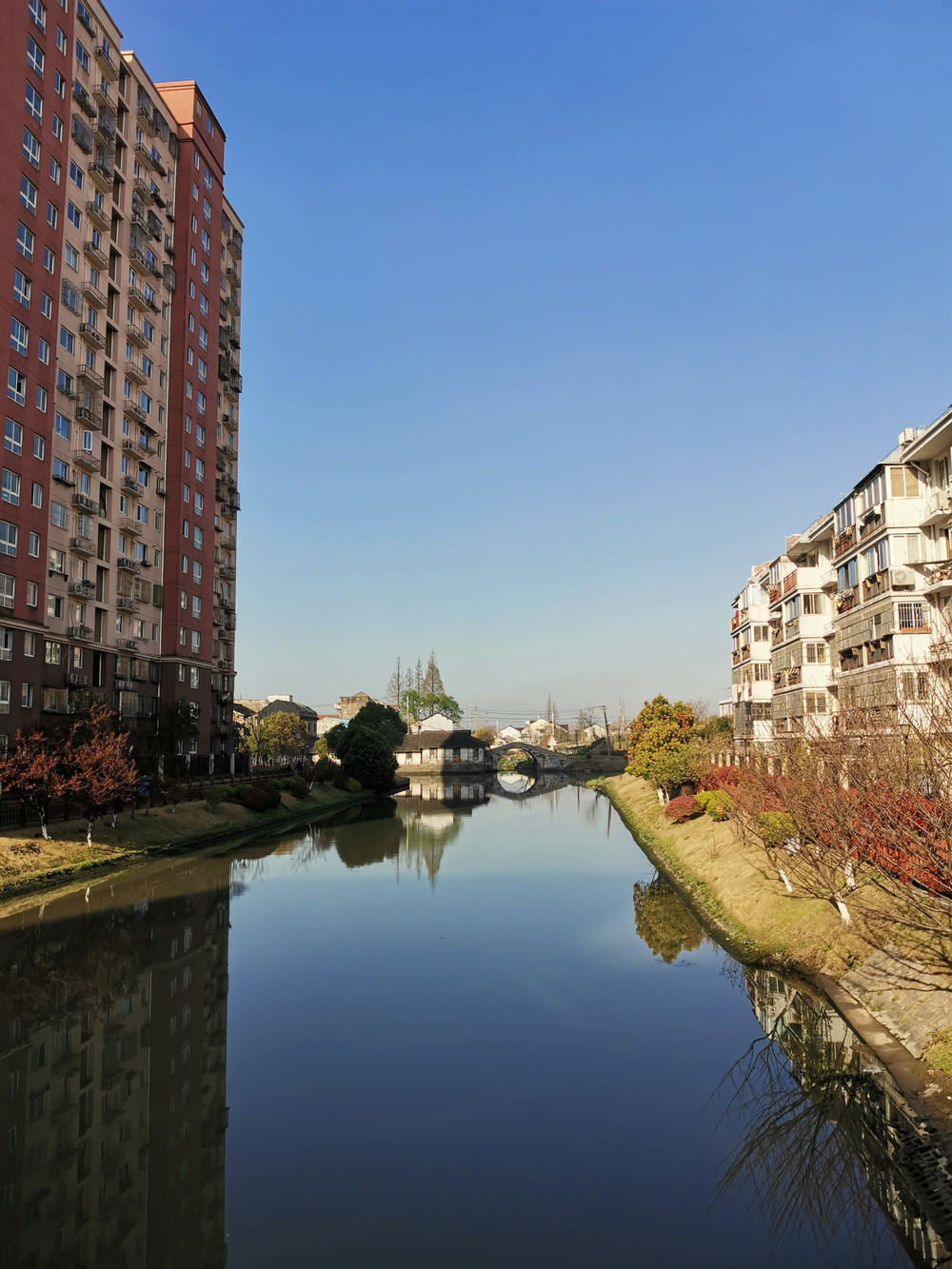
Standing on the Yongji Bridge, one can see the towering apartment buildings lining the east and west banks of Xiantan Port and the north and south banks of Wuzhao Port to the east of Xiantan Port. The Shenzhuang Pond beneath the Yongji Bridge has become somewhat silted up, and the northern section of Shenzhuang Street and the western street of Shenzhuang to the north of Yongji Bridge have vanished, replaced by the clusters of apartment buildings in Taoyuan New City’s Huifeng Apartment Complex. Beside the Yongji Bridge,The northern section of Shenzhuang Street was once known as ‘Pawn Street’ due to the many pawnshops that lined the street. Of course, by 2011, there was no trace of Pawn Street on the northern section of Shenzhuang Street, leaving only a few farmhouses and residential buildings along a street market that was tens of meters long.
Leaving Yongji Bridge and heading south along Shenzhuang Street, the middle section of Shenzhuang Street, between Yongji Bridge and Ruihe Road Xiantan Port Shenzhuang Bridge West, which is two to three hundred meters long, has only a few scattered residents left, with many houses along the street becoming empty and abandoned ruins. The somewhat dilapidated ‘one main room and two side rooms’ old house at No. 114 Shenzhuang Street, named ‘Qixiu Hall’ or ‘Xilu’, was built in the winter of the year of Bingchen (1916) and completed in the autumn of the year of Dingsi (1917). It was jointly funded by the late Qing and early Republican industrialist Zhu Xiangxiang (styled Zhu Zihao) and educator Zhu Shuyuan. This Sino-Western style building has withstood the test of time, having been used as military quarters, a hospital, a mushroom factory, a hardware factory, and civilian housing. It is said that in the future, after the demolition and relocation, only Yongji Bridge and this Qixiu Hall will be preserved on Shenzhuang Street.
Circumventing the west end of Shenzhuang Bridge, one arrives at the southern section of Shenzhuang Street. Apart from a few two-story old buildings that were once shops, most of this section has transformed into ordinary farmhouses, losing the appearance of a market town.
The red ‘demolition’ character can be seen written on walls throughout the alleys of Shenzhuang Street, indicating that even the remnants of the water town’s market town will soon cease to exist. In the twilight, take one last look at the silhouette of Yongji Bridge and the Shenzhuang waterfront by Xiantan Port; this is the last glimpse of the ancient water town of Shenzhuang as it is about to be buried and lost.
Related posts:
 Searching for the ‘Root’ in Shanghai: The Popular Songjiang District
 Free Visit to Poly Grand Theatre
 Weihai Xixiakou: Embrace a Cool and Carefree Summer
 Beijing, Tianjin, Shanghai: 10-Day Self-Guided Travel Guide
 8-Day Solo Travel to Shanghai, Guangzhou, Zhaoqing, Macao, and Nanjing
 2024 Spring Festival: 5-Day Cycling Adventure in Shanghai