Published on May 19, 2020 at 22:37.
Duration: 1 day. Play style: Independent travel.
The author visited these places: Shanghai.
On the afternoon of May 18, 2020, I came to the area around Laohutang in Muziqiao, Pudong, Shanghai to search for Dashou Bridge and Julong Bridge.
Laohutang, built in the Huangyou period of the Northern Song Dynasty.
The section of Laohutang from Muzi Bridge to Xiaowan and the rivers on both sides are well preserved.
To the east is Yukou River, also known as Dongyunyan River. To the west is Xiyunyan River.
This is the place where the ancient water conservancy landform in Pudong is best preserved and the ancient seawall style remains the most obvious.
The small river in front of us is Yukou River.
The Muzi Bridge, which was built in the 22nd year of Qianlong in the Qing Dynasty, spans the Yukou River from east to west.
Unfortunately, the ancient bridge no longer exists, but the name Muzi Bridge has been passed down to this day.
The exact location of the ancient stone bridge of Muzi Bridge is unknown. Perhaps it is on the riverbank in front of me.
The section of Yukou River at Muzi Bridge is now called ‘Donghetang Port’.
In contrast, the Xiyunyan River on the west side of Laohutang is now called ‘Xihetang Port’.
Donghetang Port is the boundary river between Heqing Town and Tangzhen Town in Pudong.
To the east of the river is Heqing, and to the west is Tangzhen.
The small village to the east of Donghetang Port is named ‘Xijiazhai’.
It is said to be a branch of Xijiazhai on Shensha Port on the west side of Laohutang.Walking along a north-south village road in Xijiazhai, I suddenly found the Julong Bridge I was looking for. This flat stone bridge spanning a small river named ‘Tuanlong Port’ runs from north to south. It is 15.7 meters long and 1.26 meters wide. The bridge deck is composed of two Jinshan granite stones that are 6.3 meters long, 0.63 meters wide, and 0.35 meters thick. The piers on both sides are made of bluestones. There are stone beams on the piers that are 2.06 meters long, 0.52 meters wide, and 0.3 meters thick. The bridge name ‘Julong Bridge’ engraved on the bridge stone is still relatively clear. Beside the bridge name are also engraved bridge construction inscriptions such as ‘Zhongyuan Gengwu’ and ’19th year of the Republic of China’. Calculating from ‘Gengwu’ and ’19th year of the Republic of China’, this bridge was built in 1930 AD. It has been about 90 years. However, there is a nameplate on the north end of the bridge that says this bridge was built in the late Qing Dynasty and early Republic of China. Perhaps Julong Bridge was rebuilt in 1930. The bridge slope of Julong Bridge is paved with granite stones. There are also relics of a path paved with blue bricks on the south side. But the road on the north side has been cut off by farmhouses. Tuanlong Port is seriously silted up. In particular, the farmhouses along the river on the south bank encroach on the river channel, making the south end of Julong Bridge almost surrounded by farmhouses along the river, affecting the view of the stone bridge.Leaving Julong Bridge and walking southwest not far, I saw Dashou Bridge. Dashou Bridge spans a small river flowing from east to west named ‘Weipu’. Both Tuanlong Port and Weipu Ta, these two small rivers flowing from east to west, converge with the Yukou River flowing from north to south. Dashou Bridge is a three-span flat-slope stone bridge. It is 12.4 meters long and 1.48 meters wide.
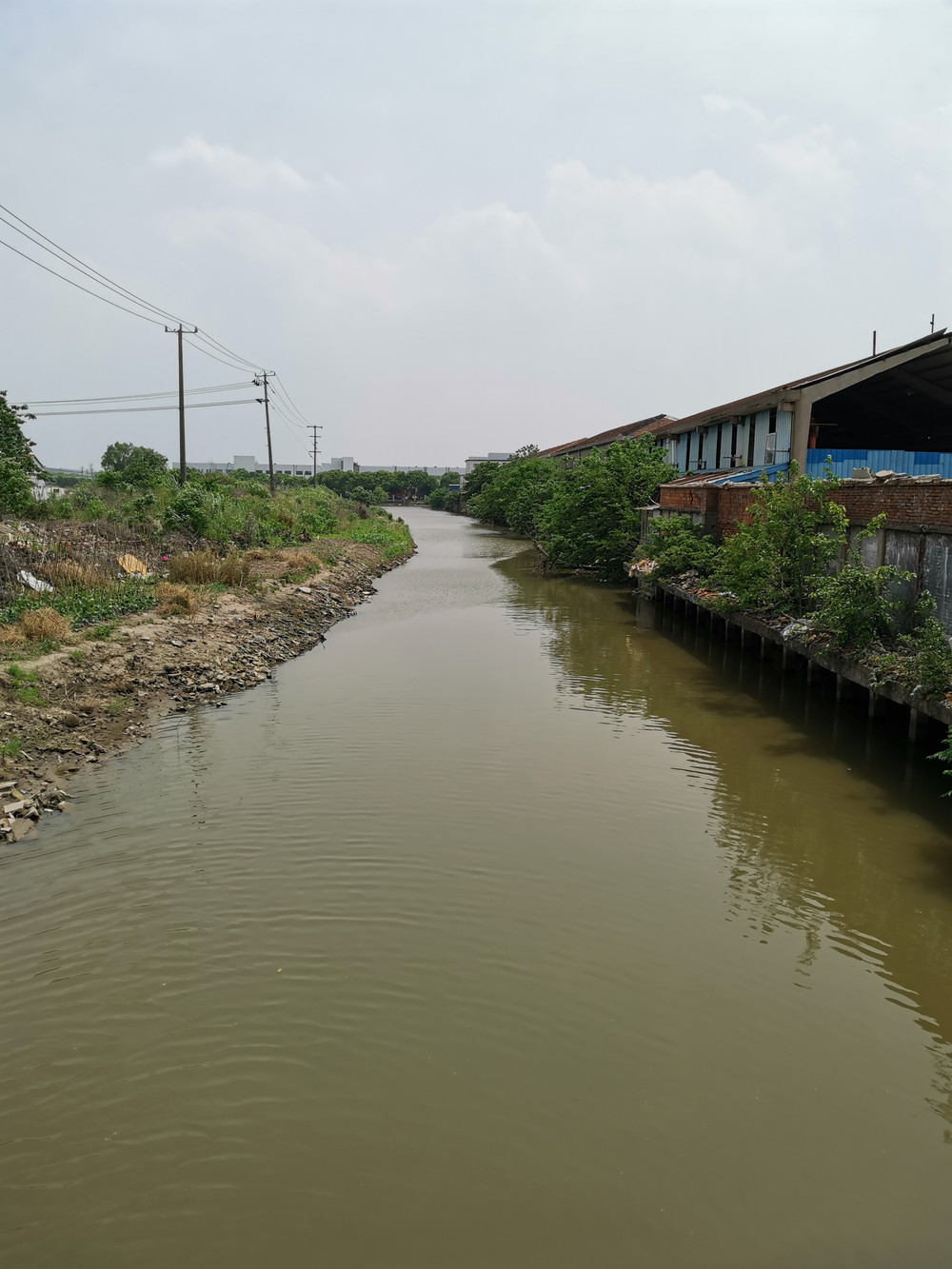
The Dushou Bridge was originally designed as a double-stone bridge, but now it is a triple-stone bridge, with the clearly added middle slab of stone. It is said that in recent years, the Dushou Bridge was a broken bridge, with the northern span’s stone arch collapsing, but it has now been completely repaired. The bridge’s north and south piers are made of bluestone blocks, with two stone slabs forming double-pier walls in the river at each bridge foot. Each pier and foot has a long stone beam measuring 2 meters in length, 0.45 meters in width, and 0.3 meters in thickness. There are two bridge couplets on the bridge feet, unfortunately covered with cement. The sides of the bridge slab are engraved with the bridge name ‘Dushou Bridge’, with two sections of bridge inscriptions next to the name on the east side. The northern inscription reads ‘Zhongyuan Dingmao Year’, and the southern one says ‘Built by Zhang Guomo’. Zhang Guomo, styled Zhuxi. From this, it can be inferred that the bridge was built in the sixteenth year of the Republic of China, that is, 1927 AD. However, the Republic of China’s ‘Chuansha County Chronicles’ records: Dushou Bridge ‘Year of construction: July of the eighteenth year; Project cost: seven hundred yuan; Donor: Zhang Zhuxi’, there is a discrepancy in the bridge construction time.Dushou Bridge, perhaps, began its construction in 1927 and was completed by 1929. The name “Longevity” is more commonly associated with stone bridges, yet the name “Dushou” is quite rare. It remains unclear why the bridge builder chose “Dushou” as the name. Was it to coincide with the donor Zhang Zhuxi’s longevity year? Or perhaps to differentiate it from the old bridge. A new concrete bridge, recently constructed on the west side of Dushou Bridge, is named “Longevity Bridge,” a name that sounds more fluent.
The 1920s and 1930s might have marked the last era of stone bridge construction history. During this time, reinforced concrete and steel structure bridges began to replace stone bridges in China, signaling the start of a new chapter in the history of bridges. The two stone bridges from the Republic of China period at Mu Zi Bridge Xi Jia Residence could represent the final vestiges of Chinese stone bridge construction. Although these two stone bridges are undoubtedly young compared to ancient ones and cannot be considered ancient, they are still old bridges. Despite not being ancient, these old bridges have withstood nearly ninety years of weathering, showing a mottled surface and gradually eroding stone carvings and patterns. In a few years, they too will join the ranks of ancient stone bridges.
As we look up, the silhouette of Chinese stone bridges is slowly fading away. Let us cherish them.
Related posts:
 Shanghai’s Historical and Cultural Origin – Comprehensive Travel Guide to Songjiang District
 Shanghai’s Niche Ways to Play: Visiting the Most Artistic Private Museum
 Off-the-Beaten-Path Cruise Vacation: A Comfortable and Perfect Getaway (Cruise Food, Fun, and Tips Guide)
 Indoor Kids’ Paradise, an Unusual Summer —- Baoyan Paradise, a One-stop Check-in Destination for Parent-child Outings in Shanghai
 Shanghai Travel: A Guide to Eat, Play, and Capture Beautiful Photos Amidst the Heatwave
 Shimao Starwood 16 Hotels Jointly Sign Contracts, Leading the New Height of National Hotel Development