The Fanghe Pavilion was built in 1078 by Zhang Tianji, a hermit in Pengcheng. Su Shi once wrote an essay titled ‘Record of the Fanghe Pavilion’, depicting a moving scene of releasing cranes with a powerful pen, making the Fanghe Pavilion and Yunlong Mountain famous all over the world. Ascending from the north gate of Yunlong Mountain and reaching the top of the third section of the mountain, on the lintel of the crescent-shaped courtyard gate are five official script characters ‘Former Residence of Zhang Shanren’ written by Tian Geng, the magistrate of Xuzhou in 1906.
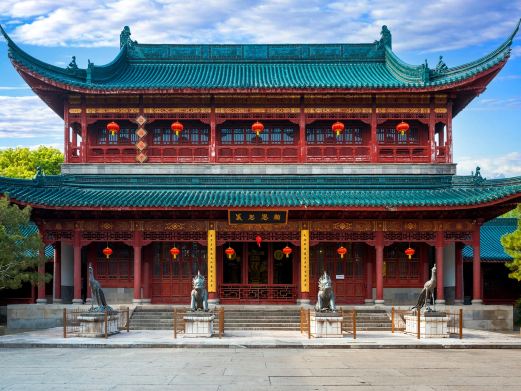
Entering the courtyard gate, there is a flat and open square courtyard paved with a path. On its east side is the Fanghe Pavilion, with upturned eaves and red pillars, grand and bright. The pavilion is 11.95 meters long from north to south and 4.95 meters deep from east to west. There is a platform in front and a corridor around it, very elegant. On the west side of the Fanghe Pavilion is the Yinhe Spring. The spring and pavilion have been adjacent for more than a thousand years. 20 meters south of the Fanghe Pavilion and more than 10 meters south of the Yinhe Spring, there is also a small pavilion named Zhaoge Pavilion built on a high place. It is named after the crane-summoning song in ‘Record of the Fanghe Pavilion’. The Zhaoge Pavilion is of brick and wood structure, small and exquisite, with eaves corners ready to fly. It is a good place for overlooking from a height. The three ancient sites of the Fanghe Pavilion, Yinhe Spring and Zhaoge Pavilion are closely related. Opening hours: Open from 9:00 to 16:30 all year round. The specific business status is subject to the opening situation on that day.Fanghe Pavilion
The Fanghe Pavilion was built in 1078 by Zhang Tianji, a hermit in Pengcheng. Su Shi once wrote an e[...]