### **Duration: 1 Day, Time: January, Cost per Person: 1 Yuan, Companion: Solo Traveler, Activities: Photography, Freestyle Travel**
The author embarked on a journey through Shanghai’s urban landscapes, capturing the essence of a city in transition. This solo adventure was a photographic and freestyle exploration, documenting the overlooked beauty and history of Shanghai’s Hongkou District.
—
### **A Glimpse of Overlooked Urban Landscapes in Shanghai’s Hongkou District: Demolition and Relocation in Jiangwan Town**
#### **I. Introduction**
On January 6th, according to a report by the Labor Daily, “Moving to a new home! Yesterday marked the collective relocation of over 800 households in six relocation plots, including numbers 340, 341, 354, and 355, in Jiangwan Town, Hongkou District. This was the first collective relocation of residents in the district after the New Year of 2020.” Inspired by this news, the author set off to Jiangwan Town to explore the unique scenery of Shanghai.
#### **II. Timeline of Events**
1. **City Leaders’ Research Visit**: On August 5, 2019, city leaders visited Jiangwan Town in Hongkou District to research the renovation of old buildings, demanding solutions to the “stay, modify, demolish” dilemma.
2. **Notice and Agreement**: On September 10, 2019, a notice was posted, and residents in six relocation plots including 340 and 341 in Hongkou District successfully passed the signing ratio.
3. **Government Decision**: On December 2, 2019, the “Shanghai Hongkou District People’s Government House Expropriation Decision” was posted.
4. **First Collective Relocation**: On January 5, 2020, over 800 households in the relocation plot moved collectively for the first time.
#### **III. Observations at the Jiangwan Town Old City Renovation and House Expropriation Base**
1. **Office of the House Expropriation Base**
2. **Announcements and Public Notices**: Various types of information were available for residents.
3. **Property Exchange Houses**:
– Songjiang District South Station (four households chose this property).
– Pudong District Huinan Town (sixteen families chose this property).
– Pudong District Cao Road (only six families chose this property).
– Jiading District Lianqi Jiacheng (only four households chose this property).
– Fengxian District Nanqiao (it seems no households chose this property).
– The nearest property to the relocation base—Hongkou District Rainbow Bay’s Mo Cui Li, with 316 available housing units for purchase, has sold 109 units.
4. **Current State of Expropriated Houses**
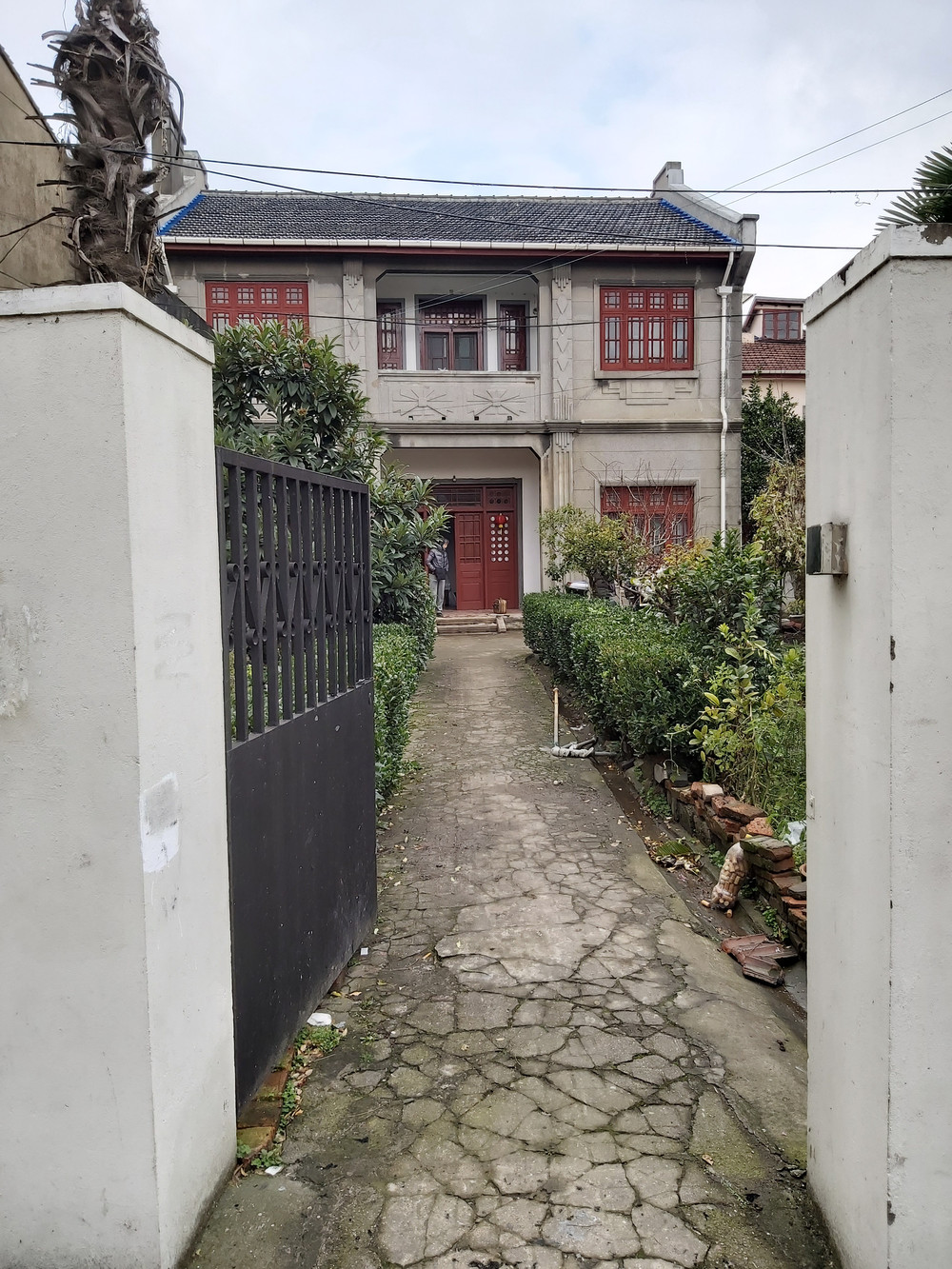
5. **A Confiscated Mansion**: This historical building has witnessed significant events, from the Anti-Japanese War to the Cultural Revolution. The house, now 88 years old, stands tall with its original floor tiles intact and a panoramic view of the garden from the second floor. The Cao family, who once resided here, also had a backyard garden with a bathroom.
#### **IV. Distinctive Street Features**
1. **Jiangwan Grain Purchase and Sale Station**: A store sign with a sense of history, unfortunately, partially blocked and unphotographable.
2. **Closure of the Sanjiaodi Vegetable Market**: On January 20, 2020, after 4 pm, the author witnessed the closure of the Sanjiaodi Vegetable Market in Jiangwan Town that had been in operation for about sixty years.
—
This journey through Shanghai’s Hongkou District provided a unique perspective on the city’s urban transformation, capturing the essence of a community in flux and the rich history that lies within its streets.**Jiangwan Vegetable Market: A Time-Honored Legacy**
*By the local residents’ accounts, the ‘Jiangwan Vegetable Market’ is not to be underestimated. With a history spanning at least sixty years, this market has earned its popularity through affordable vegetable prices. So affordable, in fact, that residents from Liangcheng New Village, Sanmen Road, Quyang New Village, and other nearby areas within a few kilometers make the trip to shop here.*
—
**The ‘Real’ Sanjiaodi Vegetable Market in Hongkou**
*Don’t underestimate the ‘real’ Sanjiaodi vegetable market in Hongkou either. It’s one of Shanghai’s 180 time-honored brands. Here are some of its accolades:*
– *In October 1993, it was named a ‘time-honored brand in China’ by the Ministry of Domestic Trade of the People’s Republic of China.*
– *In May 2010, it was again recognized as a ‘time-honored brand in China’ by the Ministry of Commerce of the People’s Republic of China.*
– *In June 2005, it was approved as a member unit by the Time-honored Brands Working Committee of the China General Chamber of Commerce.*
– *In March 2011, the registered trademark ‘Sanjiaodi’ was recognized by the Ministry of Commerce of the People’s Republic of China.*
*The Hongkou Sanjiaodi vegetable market, with a history of about 130 years, remains Shanghai’s largest indoor vegetable market after liberation and is ranked first among the four major vegetable markets in Shanghai. The others are: the vegetable market on Changshou Branch Road, the vegetable market on Julu Road, and the vegetable market on North Shaanxi Road.*
—
**A Glimpse into the Market’s Past and Present**
*On January 23, 2020, I visited the Jiangwan vegetable market again and observed the following scene. The Shanghai-style writer Lin Weiyin once penned an article titled ‘Hongkou Small Vegetable Market,’ including the Sanjiaodi vegetable market as one of the ‘hundred scenes’ of Shanghai. She described its liveliness and prosperity, mentioning its diverse operations:*
*’…The vegetable market also has diversified operations, selling Chinese bread, Russian bread, as well as groceries and fresh flowers…Among the customers of the vegetable market, Chinese people are in the majority, and there are also ‘Western housewives and Japanese kitchen maids’; the main force of customers are individuals, and of course, there are also large group purchase customers like the International Volunteer Corps…’*
*For those interested, her book offers a detailed look at the once glorious Sanjiaodi vegetable market in Hongkou.*
—
**The Impact of Relocation**
*The demolition of the Sanjiaodi vegetable market in Jiangwan Town will undoubtedly cause inconvenience to nearby residents and may signal a lifestyle change for the stall renters.*
*In this expropriation, six areas of houses are provided for the expropriated objects to choose from. One of them is in the Rainbow Bay area at the extension of Liangcheng Road in Hongkou District, which is only about 1.something kilometers away from the original homes of the relocated residents. Among the six housing sources, the number of people choosing Fengxian District is zero, and there are 109 households choosing Mocuili.*
*As the real estate is located in the urban area, with complete supporting facilities such as surrounding schools, hospitals, and nursing institutions, the selling price is nearly 50,000 yuan. Despite this, the vast majority of expropriated households still choose to purchase here. There are a total of 316 housing units, and 109 units have been sold.*
—
**Impressions and Observations**
1. *The speed of relocation in six neighborhoods such as 340 and 341 in Jiangwan Town, Hongkou District is astonishing. The household registration has been frozen several times before and after, indicating long-standing plans for this land plot.*
2. *The rapid response of residents and the speed of relocation demonstrate the attractiveness of the policies.*
3. *The policy of demolition and relocation is quite transparent and open. It is so open that an outsider like me can enter casually and see all the information inside. The wall of the housing expropriation base office displays all the policies you want to know, as well as the area information and property owner information of each household.*
4. *While it’s said that residents in Magic City turn over and get rich due to relocation, today’s situation seems somewhat one-sided. However, it is certain that relocation can improve living conditions. Those residents who are used to living in large houses all say that they will start to feel uncomfortable living.*
5. *Through the housing expropriation and relocation of this land plot, no one is seen getting rich, and no one is talking about who has gotten rich. Only the discomfort and reluctance of leaving the place where they have lived for so many years and is so convenient are mentioned.*
*First draft on January 19, 2020. Supplementary on January 20, 2020. Supplementary again on January 23, 2020. The closure of Jiangwan Triangle Vegetable Market.*