Duration: 3 days. Time: July. Companions: Parent-child. Ways of playing: Self-driving, cultural, independent travel, hiking, budget travel, saving money, weekend tour.
Published on December 24, 2020, 17:07. Tourist location: Former Residence of Fu Lei in Pudong, Shanghai.
Unexpectedly, next to the inn where we stayed is the former residence of Fu Lei. Naturally, it cannot be missed. Therefore, the former residence of Fu Lei was added to the itinerary for the next day.
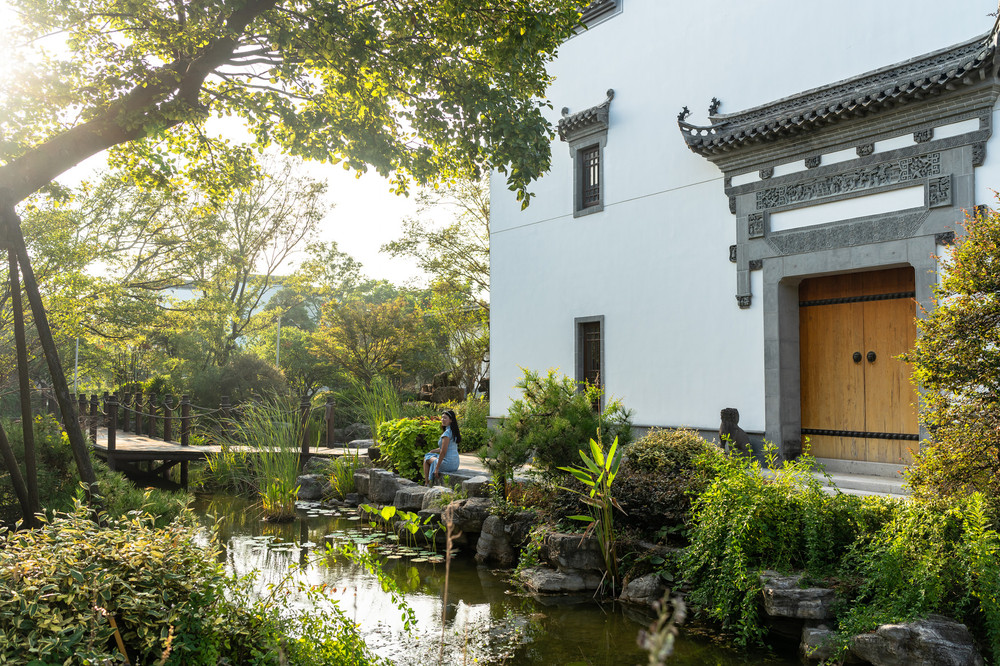
The former residence is hidden in a small courtyard. The entrance is not eye-catching at all. Fortunately, this scenic spot is marked on the omnipotent map. Otherwise, it is really possible to pass by without entering.
Walking into the alley, I still doubt if I have found the wrong place. It is clearly a residential area. The yard outside the wall is deserted. The house seems a bit dilapidated and looks as if it has been in disrepair for a long time.
It was not until someone waved to me in front of the white wall and said, ‘The former residence is here.’ that I was relieved. It seems that I am not the only one who comes following the map but cannot find the entrance.
In 1908, Fu Lei was born in the Fu family residence in Zhoupu Town. Because his cry at birth was earth-shattering, he was named Lei and his courtesy name is Nu’an. The ancestor Fu Qing moved from Haiyan, Zhejiang Province to Yancang Town today during the Yongle period of the Ming Dynasty.The Fu family, staunch believers in Confucian educational thoughts, has been engaged in farming and studying for generations, a tradition that has been passed down for twelve generations. Fu Lei, from a young age, was educated in the Four Books and Five Classics. Despite their Confucian roots, the Fu family was also liberal, inviting English and arithmetic teachers into their home, thus becoming well-versed in both liberal arts and sciences.
In the year of the May 4th Movement, Fu Lei left his private school and entered a primary school in Zhoupu Town. He was extremely intelligent and excelled academically. However, his mother’s concern for his education was so profound that she would often visit the school to supervise his studies, a practice that terrified Fu Lei. His time at the primary school in Zhoupu Town was short-lived, as he soon transferred to Shanghai.
At the age of twenty, Fu Lei went to France to further his studies. He pursued liberal arts at the University of Paris and also attended art lectures at the Louvre School of Art History. During his time abroad, his mental state began to deteriorate due to excessive studying. To recuperate, he took a short trip to Switzerland, accompanied by his landlady.
Fu Lei’s mother was very strict when it came to her son’s discipline, a trait that others perceived as somewhat unfeeling. She would often express her worries to others, saying, “I only have this one child. If I cannot discipline him well and he becomes a useless person in the future, then what hope do I have?” Indeed, Fu Lei’s later achievements were greatly influenced by his mother’s strict discipline.Fu Lei, a renowned translator, had an impressive career translating a vast array of French literature, including works by Balzac, Romain Rolland, and Voltaire. His contributions to Balzac’s translations in the 1960s were so significant that he was admitted as a member of the Balzac Research Society of France.
However, his life took a tragic turn during the Cultural Revolution. His home was ransacked by Red Guards, and he endured public humiliation and criticism for three days and four nights, including being forced to kneel and wear a tall hat as punishment. On September 3, 1966, Fu Lei and his wife were found dead by their maid; he had ingested a large amount of poison at the age of 58, while Madam Zhu Meifu had hanged herself.
The Cultural Revolution was a dark period for many, with most famous writers of the time facing persecution. Yet, many survived with tenacity. Fu Lei’s decision to take his own life might have been influenced by his childhood, which, despite his mother’s efforts to cultivate him into a scholar, writer, and translator, was far from happy. This could have made him more susceptible to giving up hope in the face of disaster.
When discussing Fu Lei, the administrator shared many insights into his life and the impact of his work. His final choice of suicide may also be related to some personality flaws caused by his mother’s discipline since childhood.The most impressive thing is still the way mother and son get along. Perhaps ordinary people cannot understand that a mother, who expects her son to become a dragon, has adopted such a harsh way?
Related posts:
 A Serene Three-Day Getaway with the Kids: A Journey through Time and Space
 Afternoon Tea: An Oasis in the British Culinary Desert
 Autumn Getaway with My Little One in the Magic City
 Shanghai’s Most Underrated Travel Destination with a Hidden Gem Hotel Offering Breathtaking Sea Views
 A Day in Shanghai During the Pandemic: January 29, 2020
 Lazy Traveler’s Guide: A Comprehensive Travel Strategy for Food, Fun, and Shopping on a Cruise