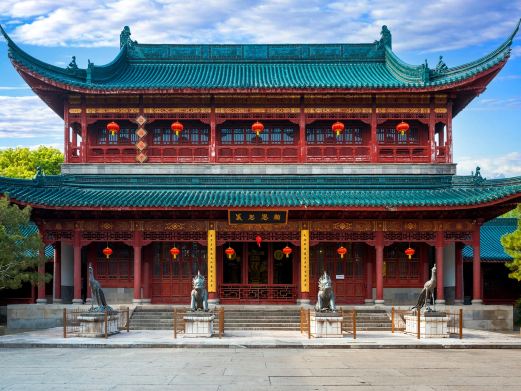
Geng Le Tang, constructed by Zhu Xiang, a hermit from the Ming Dynasty, is a quintessential example of a Ming-Qing era residence. The layout features a residential area at the front and a courtyard at the back, with thirty-four rooms in total spread across three sections. It includes a garden, a study room, a pavilion, and a pavilion with a platform. The garden comprises a lotus pond, a Mandarin Duck Hall, a Huanxiu Pavilion, and an Osmanthus Hall, among other features. The entire compound is ingeniously designed, closely integrated with nature, and fully showcases the characteristics of Jiangnan water towns.
Inside the residence, there is a root carving gallery, which houses numerous small and medium-sized root carving masterpieces, divided into three halls: a natural style hall, a Buddha statues hall, and an animal hall. In the central root carving hall on the ground floor, there is a large root carving titled ‘South Sea Qishan’. Seated in the middle is a laughing Maitreya, standing 2.7 meters tall and 3.4 meters wide, with a halo of Buddha light, a smiling face, and a left hand holding a treasure, exuding an atmosphere of joy and prosperity. The opening hours are from 08:00 to 17:00 all year round, with the actual business status subject to the day’s opening conditions.Geng Le Tang: A Typical Ming-Qing Dynasty Residence
Geng Le Tang, constructed by Zhu Xiang, a hermit from the Ming Dynasty, is a quintessential example [...]