Tang Yin (1470-1524), courtesy name Bohu, sobriquet Liu Ru Jushi. He was from Suzhou and a painter in the Ming Dynasty. He is one of the “Four Masters of the Wu School”. The site of Tang Yin’s former residence is Baohua Nunnery, also known as Wenchang Pavilion. In 1982, it was listed as a cultural relic protection unit in Suzhou. In 1505 of the Hongzhi era or in 1507 of the Zhengde era, Tang Yin chose a place in Taohuawu to build a house and named it Taohua Nunnery.
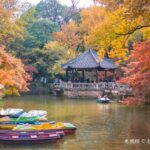
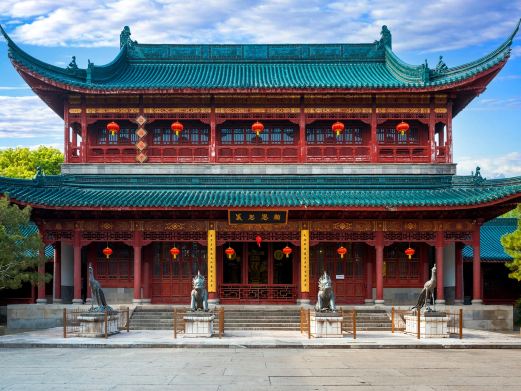
According to records, there are Taohua Nunnery, Mengmo Pavilion, Xuepu Hall, and Jiadie Studio. In the early years of the Shunzhi era of the Qing Dynasty, Shen Mingsheng, a famous doctor, obtained the site and constructed Mengmo Pavilion, Liuru Pavilion, Taohua Nunnery, Rongjing Pavilion, etc. At that time, people called it Tang Family Garden. During the Qianlong era, monks and Daoists rebuilt it into Baohua Nunnery. In the Guangxu era, it was changed into Wenchang Pavilion again. Currently, it has a construction area of 511 square meters, facing south. Roughly, it can be divided into two rows and two entrances of houses. The first entrance on the west road is a waterside pavilion built beside the pool. It has five bays with a width of 15.4 meters and a depth of 9 meters. It has a hard mountain roof. Inside, there is a ship-shaped corridor with round timber frames. The second entrance is a hall. On the east side of the waterside pavilion, there is the “Qinglian Bridge”, an ancient stone bridge in the Qing Dynasty, spanning the pool for access. The opening hours are subject to the actual opening status on the day.Site of Tang Yin’s Former Residence
Tang Yin (1470-1524), courtesy name Bohu, sobriquet Liu Ru Jushi. He was from Suzhou and a painter i[...]