**One-Day Weekend Getaway: Exploring Shanghai Museum’s Painting Gallery**
**Duration:** 1 day
**Time:** January
**With Whom:** Spouse
**Activities:** Self-driving, Cultural, Free and easy, Hiking, Budget travel, Weekend getaway
**Published on:** 2022-04-27 22:21
**Location:** Shanghai Museum’s Painting Gallery
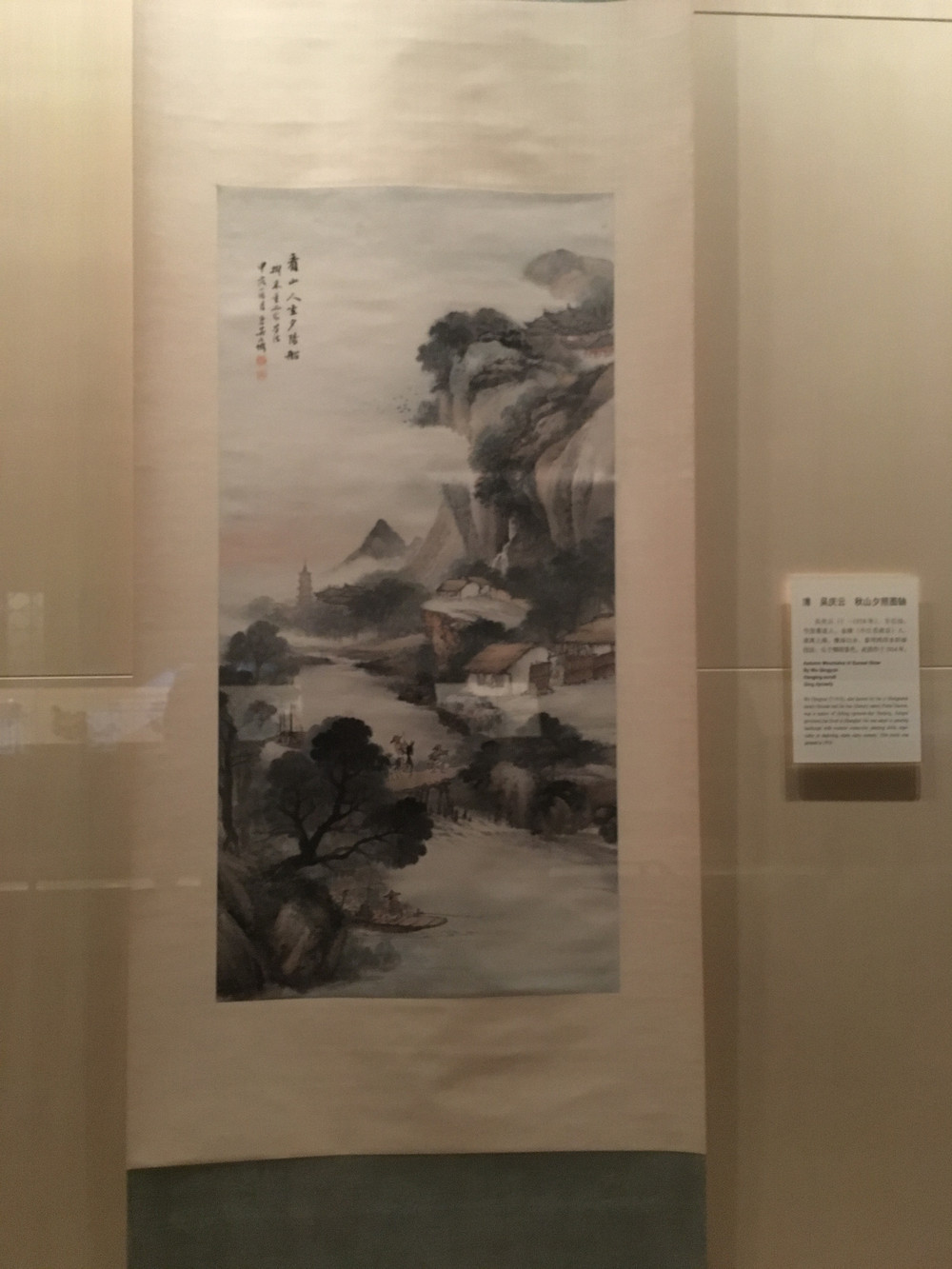
Our understanding of painting is merely superficial, yet this serves as an opportunity to learn about the history of Chinese painting development and to view the works of familiar painters. Chinese painting reached maturity during the Tang and Song dynasties, with figure painting advocating the portrayal of spirit through form, and landscape painting branching into two major systems: green-blue landscape and ink landscape. Green-blue landscape primarily uses stone blue and stone green as pigments, while ink landscape relies on the combination of water and ink, utilizing variations in ink intensity and dryness. Additionally, different regional styles emerged, with flower and bird painting establishing techniques such as fine brushwork with color, ink light color, and the boneless method that uses ink or color rendering without outline.
During the Song dynasty, the imperial painting academy was at its peak, with the Northern Song dynasty advocating a rigorous and delicate realistic style, and the Southern Song dynasty’s landscape painting style tending towards simplicity and boldness. The high simplicity and freedom of literati’s ink play painting, aimed at entertainment, also stood out outside the painting academy. Although the Yuan dynasty existed for a short time, it was an important period for black and white painting. Literati painters represented by Zhao Mengfu and Gao Kegong rejected the ornate and detailed style of the Southern Song academy painting and returned to the simplicity and naturalness of the Tang and Northern Song dynasties, advocating the integration of calligraphy into painting, initiating the Yuan painting style that emphasizes spirit over form. Zhao Mengfu was not only a great painter but also a calligrapher.
In the mid-to-late Yuan dynasty, literati freehand brushwork painting, which focuses on expressing emotions and aspirations, became the mainstream of the painting world, with subjects like plum, orchid, bamboo, and rocks becoming widely popular. After Zhao Mengfu, the ‘Four Masters of the Yuan Dynasty’ emerged: Huang Gongwang, Ni Yunlin, Wu Zhen, and Wang Meng. Flower and bird painting, while continuing the fine brushwork and heavy color style of the Song dynasty, developed the ink and wash flower and bird painting form, which also laid the foundation for later ink and wash freehand brushwork of flowers and birds.
Wang Mian’s ‘Ink Plum Scroll’ was created in the fifteenth year of the Zhizheng era, when the painter was fifty-nine years old and at the peak of his technique. Wang Mian, from Zhuji, Zhejiang, was known for his ink plum paintings. We have known about this painter since elementary school, with a text book story titled ‘Wang Mian Herding Cattle’. Ni Yunlin’s ‘Bamboo and Rock Qiao Ke Scroll’ was created in the seventeenth year of the Zhizheng era, with the author being fifty-seven years old, and it is also a very mature painting work. Ni Yunlin, from Wuxi, Jiangsu, was skilled in ink landscape painting, using dry brush and light ink. Many painters from the Jiangnan region during the Ming and Qing dynasties were influenced by him.
Ming dynasty court painting inherited the tradition of the Song dynasty academy painting, and outside the court, the Zhejiang school represented by Dai Jin from Qiantang, Zhejiang, and the Jiangxia school represented by Wu Wei from Jiangxia, competed with court painting. During the Chenghua to Jiajing reigns, the Wu School represented by Shen Zhou and Wen Zhengming emerged in Suzhou, carrying forward the tradition of Yuan painting, and the painters dominated the mainstream for a century.
Shen Zhou’s ‘Autumn Pavilion Meeting Old Friends’ is a vertical hanging landscape painting, which the artist created at the age of fifty-eight. Shen Zhou, a native of Wu County, Jiangsu, excelled in landscape and flower-and-bird paintings. He is known as one of the ‘Four Masters of the Ming Dynasty’ along with Wen Zhengming, Tang Yin, and Qiu Ying. In fact, Tang Yin’s painting was greatly influenced by him, and Wen Zhengming was his disciple. Tang Yin’s ‘Apricot Blossom Fairy Pavilion’ depicts both distant and close scenes with meticulous detail, but personally, I think his figures and plum blossoms are painted even better. Tang Yin is highly renowned, and almost everyone in the country knows him, probably due to his romantic story ‘Tang Bohu Points Qiuxiang’. Following Shen Zhou as the leader of the Wu School of painting was Wen Zhengming, and there is also an ink landscape painting by him in the museum. Shen Zhou’s paintings are known as ‘rough Shen’ and ‘delicate Shen’, and Wen Zhengming’s paintings also have ‘rough Wen’ and ‘delicate Wen’. Xu Wei, styled Wenchang, from Shaoxing, Zhejiang, was excellent in landscape, figures, flowers and birds, insects, and fish, pioneering a new style of freehand ink painting.The museum houses Shen Shichong’s awe-inspiring ‘Ten Thousand Miles of the Yangtze River’, a painting created in the first year of Chongzhen’s reign. Soon after, widespread suffering ensued. Dong Qichang, in the late Ming Dynasty, synthesized the essence of Song and Yuan painting, which was followed by the early Qing ‘Four Kings’ who revered ancient masters. The Four Monks and artists like Mei Qing and Gong Xian emphasized learning from nature and expressing their personal character. Painters such as Wu Bin and Chen Hongshou had strange and unique painting styles, while Yun Shouping revived the boneless flower painting technique, opening a new realm for lifelike flower painting.
In the mid-Qing Dynasty, the Loudong School and the Yushan School dominated the orthodox art scene, with many followers. The Qing Dynasty’s imperial painting academy flourished from the Kangxi to Qianlong dynasties, deeply influenced by the ‘Four Kings’. Flower and bird paintings popularized fine brushwork and Yun’s boneless method. The royal family absorbed Western painters, leading to a blend of Chinese and Western painting styles. Disappointed literati in the Yangzhou area took up painting as a profession, creating a new and distinctive artistic form known as the ‘Yangzhou School’. The most famous among them are the ‘Eight Eccentrics of Yangzhou’. Zheng Banqiao is probably the most well-known, mainly because his ink bamboo is unparalleled and has been stamped with a strong personal mark. His seven-character quatrain ‘Bamboo and Rock’ was selected for textbooks and sung by Xiao Zhan in the classic recitation program, spreading even wider. His ‘Bamboo, Rock, and Orchid’ painting in the museum is a representative work of Zheng’s style.
In the late Qing Dynasty, the study of calligraphy and stele scripts flourished, and painters absorbed the spirit of bronze and stone inscriptions, forming a school of painting represented by Wu Xizai, Zhao Zhiqian, and Wu Changshuo, among others. After the mid-19th century, the opening of ports for trade in Shanghai, Guangzhou, and other places attracted painters from all directions. There was the ‘Shanghai School’ in the Shanghai area and the ‘Lingnan School’ composed of Guangdong painters.
Wu Changshuo’s ‘Album of Flowers’ was created in 1916 when the painter was seventy-three years old. One can see his proficient techniques and mature brushwork. Hailing from Anji, Zhejiang, Wu Changshuo later moved to Shanghai and became adept at painting freehand flowers. His fame extends beyond his paintings, as he was the first president of Xiling Seal Engravers’ Society in Hangzhou. His achievements integrate poetry, calligraphy, painting, and seal engraving, combining metal, stone, calligraphy, and painting into one art form. He is known as ‘the first person of Stone Drum seal script’ and ‘the last peak of literati painting’.
Related posts:
 Shanghai Journey | Staying at the Peace Hotel, Stepping into the Legendary History of Old Shanghai, and Witnessing the Glamour and Vicissitudes of the Bund!
 Exploring Sheshan in Shanghai for Culinary Delights
 Cycling Diary 5 – Exploring the Bass Homeland
 An Invitation to a Gorgeous Summer with Hilton Group
 Explore Shanghai in Summer Vacation: These Places Are Worth Adding to Your Favorites
 Plant a Seed in Children’s Hearts: Two Days and One Night Children’s Tea Ceremony Tour