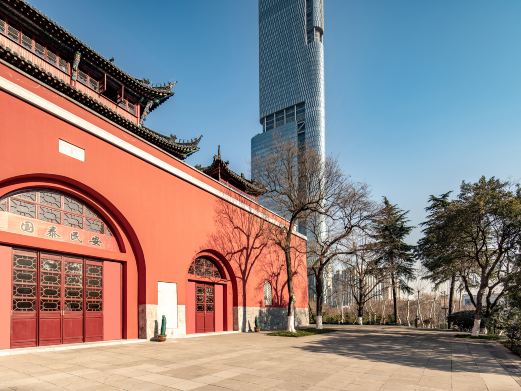
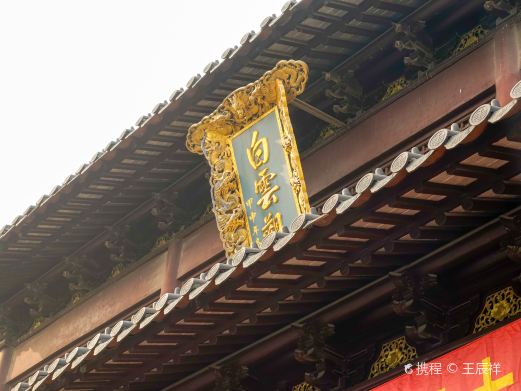
The Xianhe Temple in Yangzhou is shaped like a crane and is well-preserved. It is a clever combination of Chinese and Arab architectural styles. Xianhe Temple was built in the first year of Song Deyou (1275). To this day, there are still Islamic cultural relics from the Song, Yuan, Ming and Qing dynasties. When building the temple, Puhading laid out according to the shape of a crane from the ‘beak’ to the ‘tail’. Opposite the main gate, there was originally a screen wall as the ‘crane beak’ (demolished in 1958). The temple gate is a pailou with upturned corners, just like a crane’s head raised. From the temple gate to the main hall, there is a long, narrow and curved corridor, shaped like a crane’s neck. The main hall is equivalent to the crane’s body. On the north and south sides of the main hall, there are half pavilions with upturned eaves, like crane wings (the half pavilion on the south side is the Moon-Watching Pavilion, and the half pavilion on the north side has collapsed). In the courtyards on the left and right sides behind the main hall, there are two ancient cypresses, which are called crane feet. Originally, there was a river behind the hall, with bamboo groves planted all over, shaped like a crane’s tail (after filling in the Wenhe River and building roads, the bamboo groves no longer exist). On the left and right sides in front of the main hall, there is a well each, regarded as crane eyes. On the vermilion horizontal plaque at the front of Xianhe Temple, golden Arabic characters – Tasmim (Great Compassion) are engraved. On the horizontal plaque in the middle of the back hall kiln door, there are one hundred circles, and each circle is engraved with gilded Arabic characters.
Opening hours: Open all year round and all day. The exterior is open all day.Xianhe Temple
The Xianhe Temple in Yangzhou is shaped like a crane and is well-preserved. It is a clever combinati[...]