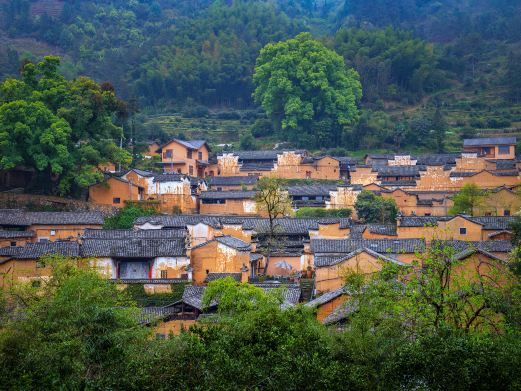
Yangjiatang Village is located in Sandu Township, with the village facing west from an eastern orientation. According to records, the village was established around 1655, and it has a history of over 350 years. During the 12th year of the Qing Dynasty’s Shunzhi period, Song Xian Kun settled in Yangjiatang. The origin of the village’s name is described in the Songyang County Gazetteer: it was initially called Zhangjiaotang due to the presence of three intersecting camphor trees in the village, which was later changed to Yangjiatang. The villagers of Yangjiatang primarily earn their income from tea and fruit cultivation, as well as working outside the village.
The village is a culturally historic ancient village with a beautiful environment, and eight ancient residences are well preserved. Upon entering Yangjiatang, the most eye-catching features are the orderly rows of ancient buildings from the Qianlong period of the Qing Dynasty and the layers of opposing horse-head walls. This also includes the exquisitely carved beams, painted rafters, and door and window carvings. The wall culture of Yangjiatang is very rich, reflecting the life beliefs and artistic pursuits of people at the time from one aspect. The entire text is open all year round, 24 hours a day, with specific operating conditions subject to the day’s opening status.