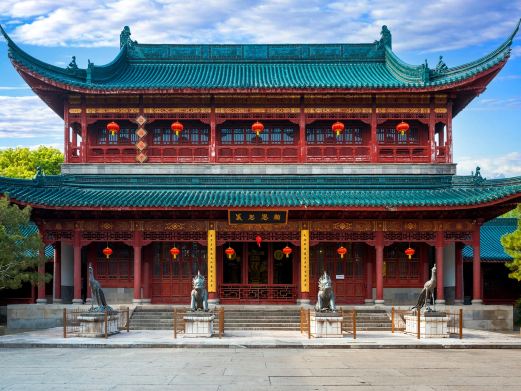
Yingjiang Temple stands majestically on the bank of the great river in the east of the city. It was formerly known as Huguo Yongchang Zen Temple and also called Wanfo Temple. It was first built in 974, the seventh year of Kaibao in the Northern Song Dynasty. In 1619, the forty-seventh year of Wanli in the Ming Dynasty, Ruan Zihua, a gentry in the county, raised funds for renovation. The halls are magnificent and the momentum is majestic. It is a famous temple along the river.
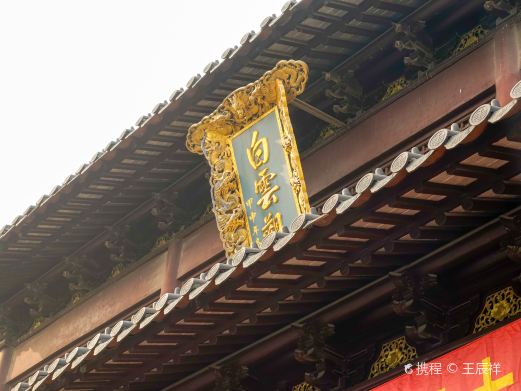
Tour guide: The temple is composed of ancient building complexes such as halls, chambers, pavilions, towers, houses and gardens, covering an area of 22,000 square meters. On the mountain gate facing the river are embedded three regular script golden characters of ‘Yingjiang Temple’ written by Emperor Guangxu of the Qing Dynasty. They are powerful, steady and shining. On the white marble door coupon are embedded reliefs of four-clawed divine dragons. On the left and right of the mountain gate are placed large iron anchors weighing about 3 tons, which are not found in other temples. According to folk legends, Anqing’s terrain is like a ship. The tower is like a mast. If it is not anchored and stabilized, Anqing City will float eastward with the river, so they are set up. Entering the mountain gate is the Heavenly King Hall. Maitreya Buddha is sitting in the shrine. The Four Heavenly Kings are lined up on both sides with different expressions. Ascending 28 steps is the Mahavira Hall with the plaque written by Zhao Puchu. Behind it is the Pilu Hall. The gods and Buddhas Vairocana and the two great heavenly kings, Indra and Brahma, look solemn and majestic and dominate the hall. Behind the hall is the group sculpture of the Four Seas Dragon Kings facing Guanyin on the ‘island’. The fourth hall is the Sutra Depository Tower, which houses treasures such as the gilded ‘Sutra of the Lotus Blossom of the Wonderful Dharma’ bestowed by Emperor Guangzong of the Ming Dynasty and the sketch portrait of Avalokitesvara. Nearly 500 statues and Buddhas are enshrined in the whole temple. There are also golden plaques ‘Good Lion’s Roar’ and ‘Wonderful Mirror of Bright Garden’ bestowed by Emperor Qianlong of the Qing Dynasty and Empress Dowager Cixi. Opening hours: Open all day all year round. The specific business status is subject to the opening situation on that day.Yingjiang Temple
Yingjiang Temple stands majestically on the bank of the great river in the east of the city. It was [...]