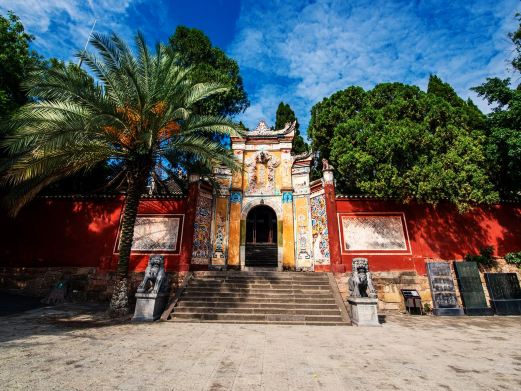
Zhaomu Mountain Forest Park, nestled in the heart of the Northern New District, is a small mountain range that stretches from east to west, characterized by its meandering and gently undulating terrain. This area boasts excellent natural vegetation, offering a distinct hilly and mountainous natural scenery. Leveraging its natural geographical advantages and the rich heritage of filial piety culture, the park embraces an ‘eco-friendly’ philosophy, crafting a natural ecological landscape that seems to have been formed by nature itself.
Spanning an area of 4,300 acres, Zhaomu Mountain Forest Park is home to thousands of species and nearly 100,000 plants. The lush and dense vegetation creates a verdant tapestry that defines the park’s green essence. Traditional Chinese gardening techniques are employed throughout the park, with a mix of species, varying age structures, and multi-layered forest compounds. Nearly ten thousand large trees have been planted, contributing to the park’s grand and atmospheric plant landscape.
The architectural design within Zhaomu Mountain Forest Park reflects the style of traditional residences. Features such as courtyards, corridors, pavilions, towers, gates, and plaques are all present, harmoniously integrating with the forest landscape. The layout is thoughtfully planned, with a strict control on the number of structures, showcasing a unique style marked by exquisite craftsmanship, high-quality materials, and a traditional aesthetic. The primary building material is wood, supplemented by locally sourced stone. The architecture is characterized by traditional elements such as flying eaves and corners, blue tiles, white walls, and decorative flower windows and eaves.The paving materials are exquisitely selected, mainly using natural materials such as volcanic stone, white marble, yellow sandstone, pebbles, blue bricks, and blue tiles, adopting traditional paving techniques.

Culture is where Zhaomu Mountain Forest Park has its charm. Buildings, landscape stones, plaques, couplets, inscriptions, and plants serve as cultural carriers, blending into the park’s geographical environment and green background, seemingly scattered inadvertently, flowing with a dense cultural atmosphere.
Cultural relics from the Ming and Qing dynasties, such as the ‘Fidelity and Filial Piety Archway’ and the ‘Loyalty and Filial Piety Archway’, are historical witnesses of filial culture preserved to this day.
‘Zhaomu Mountain Villa’ is a filial culture building based on Feng Shihang’s interpretation of Zhaomu Villa, and plants like daylilies, filial bamboo, and Chinese toon trees are rich in filial love significance.
The tiles and ridges are cast with the seal script ‘filial piety’ in yang, while the yellow sandstone column bases are engraved with the seal script ‘filial piety’ in yin.

The couplets in various places use Chinese calligraphy and couplet formats to promote ‘filial piety’ and ‘love’.
The parent-child paradise has 12 stone carvings of the character ‘filial piety’, including oracle bone script, bronze script, small seal script, clerical script, regular script, running script, and cursive script, tracing the development sequence of Chinese characters, and at the same time, engraving the classic chapters of the Classic of Filial Piety.The park features a multitude of landscape stones, each adorned with poems and verses meticulously carved in the style of renowned calligraphy masters. It remains accessible to visitors throughout the year, with operating hours from 6:00 AM to 10:00 PM.