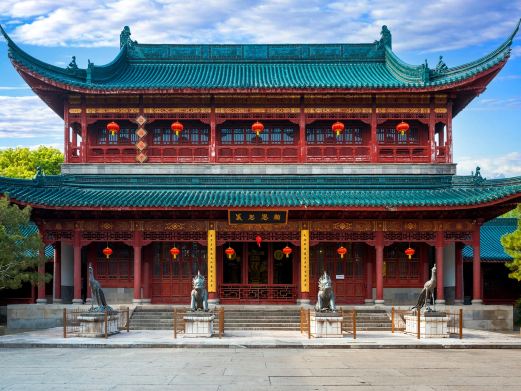
Zhuwang Village, established over 1300 years ago, is one of the five ancient villages in Jingde County, known for its Hui-style architecture. It boasts a profound cultural heritage, long-standing humanistic history, and unique architectural landscapes. It is said to be the residence of the descendants of the Song Dynasty’s Neo-Confucian master Zhu Xi. There are 47 well-preserved buildings from the Ming and Qing dynasties, with residential buildings arranged in a rational and distinctive manner, embodying the typical Hui-style architectural features.
The village also preserves the relatively intact private school – ‘Fushan Academy’, and the ‘Tea Character’ old pawnshop. The Zhuxi River, located in the center of Zhuwang Village, was artificially excavated by the ancestors of the Zhu family, presenting a unique water system where water flows from north to south. There are nine wells along the river used for drinking in the past and thirteen stone bridges made of huge bluestones, collectively known as ‘Nine Wells and Thirteen Bridges’. According to the legends of the elders in Zhuwang Village, the village was destined to produce nine Jinshi (advanced scholars), and the Zhu family’s reign was to span thirteen dynasties. The ‘Xianyun Pond’ in the upper reaches of the Zhuxi River was where Zhu Zedan, one of the brothers from Zhuwang Village who were Hanlin scholars during the Ming Dynasty, studied by moonlight. His handwritten cliff inscription ‘Xianyun Pond Shadow’ is clearly discernible, and the remains of the ancient stage by the pond are faintly visible. ‘Longtan Waterfall’, with three cascades; ‘Guanyin Temple’ and ‘Dragon King Temple’ reflect the ancients’ hopes for prosperity and favorable weather. Zhuwang Village, nearly a thousand years old, has a simple folk custom, mainly with the surnames Zhu, Wang, Fang, Lv, Zhong, and Liu, with the Zhu surname being the most common, descendants of the Southern Song Dynasty Neo-Confucian Zhu Xi (1130-1200). The village is full of Hui-style architecture, with blue bricks, black tiles, and horse-head walls. During the Ming and Qing dynasties, there were two ancestral halls, four temples for land, Guanyin, and the Crown Prince, and two chastity arches. Renowned commercial brands included ‘Caizi’, ‘Qianyuan’, and ‘Xinglong’. During the Ming and Qing periods, Zhuwang Village flourished with towering stone archways, majestic ancestral halls, temples with lingering incense, long-lasting ancient music from the stage, a crowd of merchants, and numerous shops. It is said that there was also a geomancer who made a contribution. The story goes that the Zhu family offended the Cai family because the Zhus built a bridge over the Hui River, and the pigs (Zhus) crossed the bridge to eat all the vegetables (Cais), leading to the decline of the Cai family. To vent their anger, the Cai family hired a geomancer to dig an artificial river in the middle of Zhuwang Village. Imagine, once the pig (Zhu) was gutted, could it still live? Legends are just legends,经不起推敲, and there is no need for verification. However, this ancient village still stands with its unique charm, through the ages, enduring all weathers, to this day. Opening hours are from 08:00 to 17:00 all year round. Preferential policies: Children under 1.2 meters (not including) enter for free; Elderly people aged 70 and above with an elderly card or ID card enter for free.Zhuwang Village – An Ancient Village with Rich Cultural Heritage
Zhuwang Village, established over 1300 years ago, is one of the five ancient villages in Jingde Coun[...]