**Trip Duration: 3 Days**
**Timeframe: July**
**Companions: Parent-Child**
**Activities:**
– Photography
– Self-driving
– Cultural Exploration
– Independent Travel
– Hiking
– Saving Money
– Weekend Trip
**Visited Location: Shanghai Changxing Island**
**Posted Date: December 25, 2020, 19:43**
**Flower Viewing Spot: Shanghai Changxing Island Wetland Park**
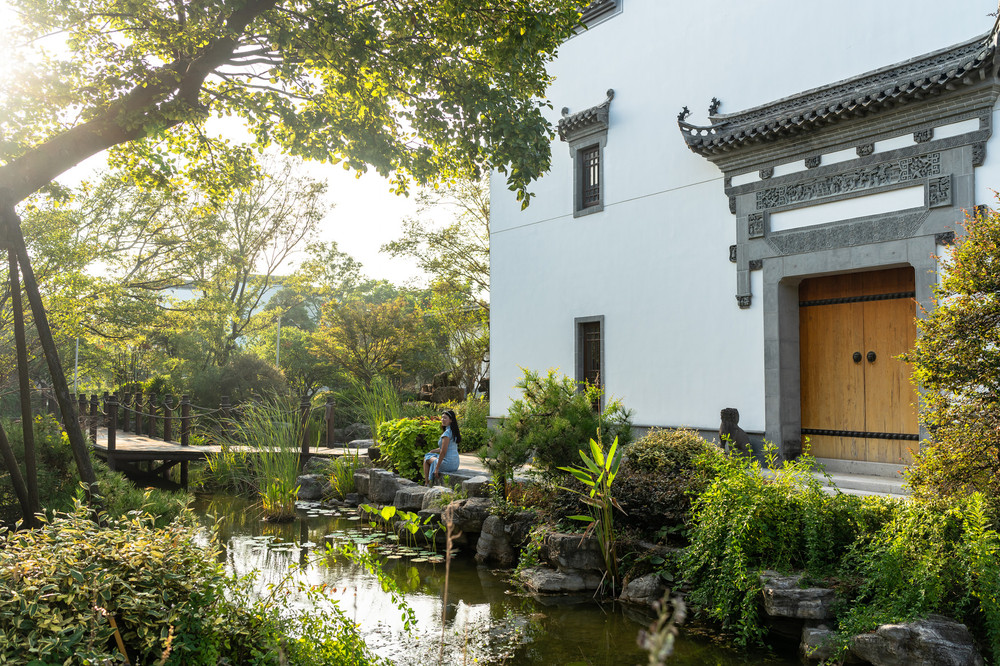
During our visit, the ponds filled with lotus flowers at Shanghai Changxing Island Wetland Park made us feel that the trip was already worthwhile. However, the sight of agapanthus was an even greater surprise, surpassing the allure of the lotus. While the lotus, a seasonal summer flower, offers its elegant charm annually, agapanthus is a different story. Having only seen one or two plants before, this was my first encounter with them in such abundance.
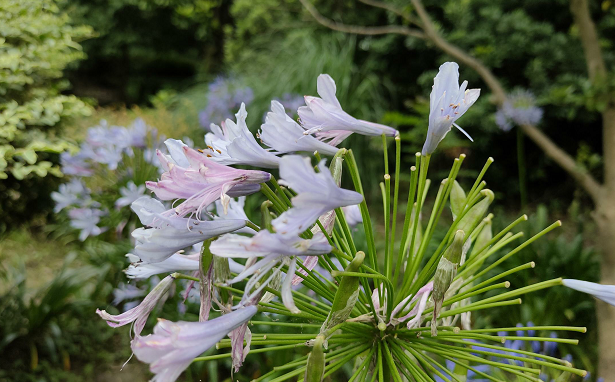
Agapanthus, a member of the Amaryllidaceae family, is a perennial herb. Its scape rises from the leaf cluster, reaching up to approximately 80 centimeters in height, and features an umbel inflorescence. When in full bloom, it resembles an umbrella, the kind that ancient ladies would carry tilted on their shoulders. The flowering period for agapanthus is typically from July to September, making our visit perfectly timed.
Initially, agapanthus was classified under the Liliaceae family and is also known as the African lily. Although each individual flower on the branch is not large, upon closer inspection, the shape bears a resemblance to lilies. There are, of course, some taxonomical classifications that place it within the Amaryllidaceae family.Later, a new Agapanthaceae family was simply established, so agapanthus was separated out. Later, both the Alliaceae family and the Agapanthaceae family were merged into the Amaryllidaceae family, so agapanthus was completely classified as belonging to the Amaryllidaceae family and the Agapanthus genus, and there is no more controversy. Of course, we don’t know if there are different ideas in the academic community. We only know that when it comes to agapanthus now, it is considered a plant of the Amaryllidaceae.
According to the determination results of DNA sequences, the agapanthus genus is divided into 6 species and 14 subspecies, including deciduous species and evergreen species.
In the colorful world of flowers, blue flowers are not common. Many colorful flowers lack the blue color series. The blue-purple of agapanthus is very pure, and the flower shape is very beautiful. In summer, it is like a clear stream. The intense heat of midsummer seems to be driven back a bit, and people feel cool psychologically.
Each branch of agapanthus will have at least 10 small flowers blooming, and some can even reach 50. Even a single branch of agapanthus is also very ornamental. Of course, precisely because the inflorescence contains too many small flowers, it is difficult to see the entire inflorescence fully open. On each flower branch, there are always blooming, half-open, and budding ones.
Its meaning is also very good. The meaning of ‘many children’ always makes people very fond of it.The Agapanthus, a flower with a very Chinese-sounding name, is not commonly seen in parks in the Jiangnan region, perhaps due to the challenges in cultivation. Originating from the distant Cape of Good Hope in South Africa, this flower was introduced to China in more recent times. Its flower language represents the feelings between lovers, logically making it a kind of flower that should be very common. However, its cultivation requires warm, humid environments with ample sunlight, needing warmth in winter and coolness in summer, which makes it difficult to cultivate outdoors in the north. In the south, it can withstand the winter but can easily suffer from yellowing leaves if the indoor environment is not suitable.
Despite these challenges, the Agapanthus remains popular in flower shops due to its elegant color and flower shape. Even without other flowers to accompany it, a few stems placed casually in a vase are quite beautiful. Like red flowers, blue flowers also need green leaves to complement them. In addition to blue, the Agapanthus also comes in white, but white ones are not common in parks, making finding one occasionally a delightful surprise. There are据说other colors, but they are quite rare. Although I have not seen its diverse colors, I believe that the deep blue and pure white are more than enough to support its aesthetic appeal.
Related posts:
 Autumn Cruise with Parents: Embracing the Ocean Spectrum
 Yangpu’s Xinjiangwan City Park: A Treasure Trove for Lotus Appreciation
 Revisiting Shanghai Amidst the Pandemic: A Journey in 2020
 Bring Your Child to Shanghai, the Magic City. Have a Wonderful Journey with Dinosaurs at Songcheng. A Nanny-level Guide for You
 Cool Refreshment at Shanghai Haichang Ocean Park on a 38°C Late Summer Day
 Shanghai Travel Guide