**Journey to Fengjing Ancient Town: A Day of Solitude and Discovery**
**Duration: 1 Day | Companion: Solitude**
**Visited Locations:**
– North Street of Fengjing Ancient Town
– Shanghai Shikumen
– Jinjiang Amusement Park
– Cheng Huang Temple
– Chinese Peasant Painting Village
**Published on: 2020-10-31 14:35**
**Fengjing Ancient Town: A Glimpse into History**
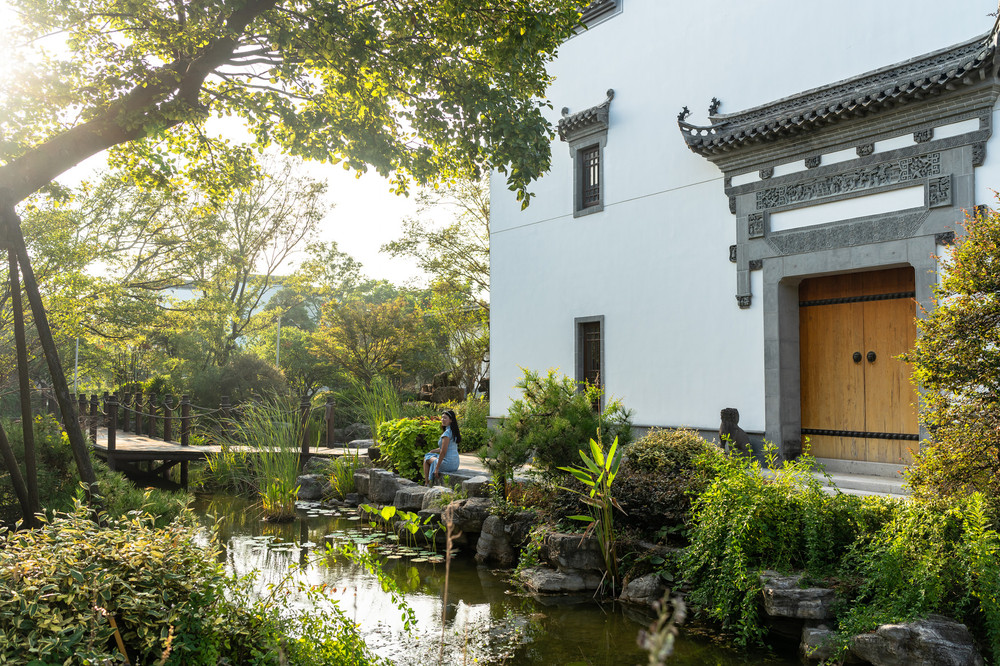
Fengjing Ancient Town, with a history spanning over 1500 years, was once part of the ‘Land of Yue’ and is a quintessential Jiangnan water town. Surrounded by an extensive network of waterways, it is renowned for its crisscrossing rivers and bridges, often described as ‘three steps and two bridges, ten ports at a glance’. The well-preserved historical streets such as Peace Street, Production Street, North Street, and Friendly Street feature ancient buildings mainly in Ming and Qing styles, exhibiting the traditional Jiangnan characteristics of whitewashed walls and black tiles.
**Notable Figures and Local Delicacies**
Notable figures from Fengjing include Ding Cong (a master of comics), Cheng Shifa (a master of traditional Chinese painting), and Zhu Xuefan (the first postmaster general). The four treasures of Fengjing are Shanghai Shikumen rice wine, Fengjing Ding’s pork trotters, dried tofu, and champion cake.
**Urban Escape to the Ancient Town**
After spending too much time in the city, I felt the urge to explore the surrounding areas. Previously, when my company was in Jinshan, I only traveled back and forth by shuttle bus, having heard of Fengjing Ancient Town but never visiting. This month, I was determined to take a stroll and found out through Baidu that there was a direct bus from Jinjiang Amusement Park, which was quite convenient.
**Route and Travel Experience**
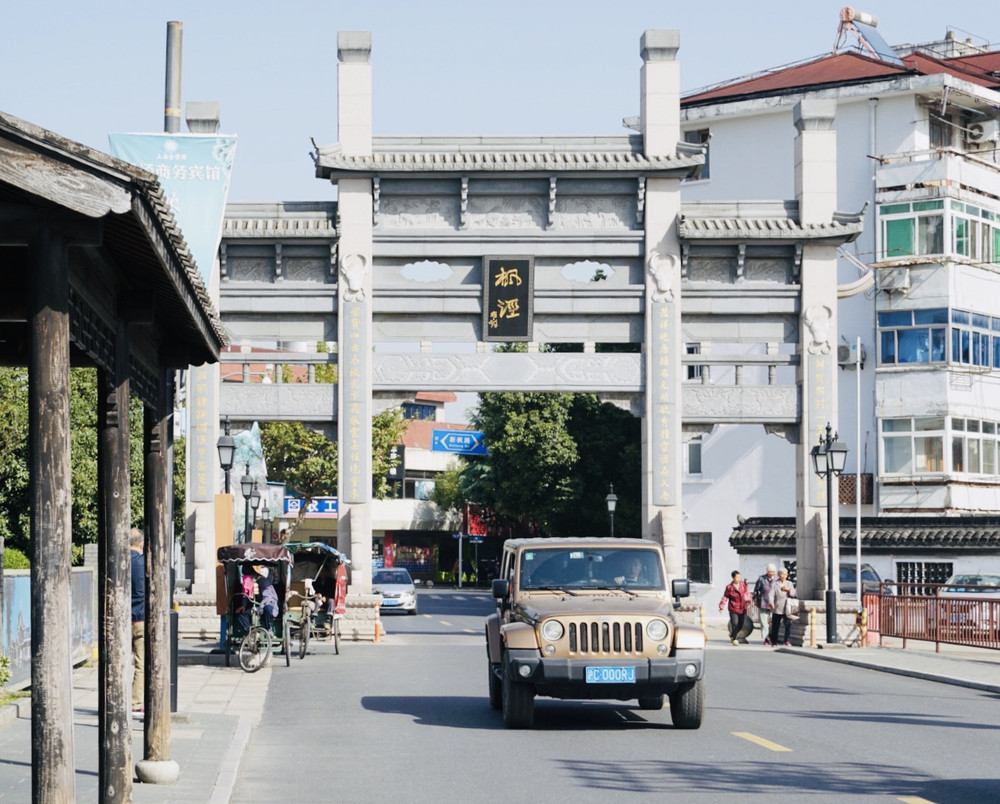
On October 23, 2020, I took the Fengmei line at the southwest bus station of Jinjiang Amusement Park. The trip was exceptionally smooth; as soon as I arrived at the station, a Fengmei line bus was there, and it took about an hour to reach under the Fengjing archway. Along the way, the walls were imprinted with the Qing Dynasty poem ‘Fengxi Bamboo Branch Words’ by Shen Rongcheng, complete with explanations and illustrations, making me feel as if I had traveled back in time to that era.
**Fengjing Archway and Fengxi Long Corridor**
Fengjing Archway: An archway in ancient style, with the prominent characters ‘Fengjing’ written by the late master of traditional Chinese painting, Cheng Shifa. The archway stands 12 meters high and 14 meters wide, with three rooms and four columns.
Fengxi Long Corridor: Originally over 1000 meters long, now restored to 268 meters, it is said that ‘one does not need an umbrella in summer, nor boots in the rain’.
**Wu Yue Boundary Stone and Local Charm**
The Wu Yue Boundary Stone: During the Spring and Autumn Warring States period, this river marked the boundary between Wu and Yue, with Wu to the north and Yue to the south.
White walls, black tiles, small bridges, and flowing water—because I was wandering alone, I noticed a Ctrip audio guide promotion on the side of the road, so I scanned the QR code and paid six yuan to get a general understanding of the characteristics of each attraction.
**Cultural Encounters and Personal Reflections**
The coffee shop in the hit drama ‘Nothing But Thirty’, where Wang Mani’s hometown was filmed, had not yet opened at around 10 o’clock. The shop’s specialty drink, this DDT is not a pesticide (when I was young, I often heard adults say that someone from a village had a quarrel and drank DDT to commit suicide, and seeing it here brought back memories from my childhood. At that time, I was ignorant of death and indifferent to the departure of others. However, as I grew older, I realized that the loss of a loved one is a pain that goes to the bone).
After browsing the interior of the coffee shop, I returned to Qiongchi No. 9 around 2 pm, ordered a crepe, and sat by the river in a daze.
**Strolling and Discovering Local Life**
Strolling leisurely along the Fengxi Long Corridor, there was a wall engraved with a poem by Shen Rongcheng. Ah Liu’s Shaomai shop is now full of large meat zongzi in the ancient town. This is bullfrog, not frog! When I was a child, every summer was about catching frogs; I had not heard of bullfrogs back then. After school, I would use caterpillars or frog legs as bait—feeding them to ducksHowever, adults generally did not allow children to go on their own, as there were risks of sinking into the mud and not being able to get up. Thus, we would secretly go, and if our clothes got wet, we would dry them and act as if nothing happened upon returning home—these childhood memories are still very pleasant to recall.
The Eastern District Fire Bureau, built in the early years of the Republic of China, was then called the ‘Dragon King Hall’ (also known as the Firefighting Association), symbolizing the sea dragon king’s power over fire. It was the location of the Fengjing Eastern District Fire Bureau during the Republic of China period and is also the only relatively complete modern firefighting institution site remaining in the Shanghai area.
The firefighting boat: This is the last retired firefighting boat in the Shanghai area, built in 1952 and retired in 1993 after 41 years of service.
After crossing Taiping Bridge, you arrive at the Fengjing Ancient Stage on Heping Street: The stage was an outdoor platform specifically for performances in ancient times. The Fengjing Ancient Stage is located in the City God Temple Square, with one side facing the street and the other the river. Whenever there was a performance, audiences coming by boat could watch from their vessels. Wealthy families would build stages in their courtyards or ancestral halls, while ordinary rural areas would set up stages in open fields near the village or on drying grounds. The latter, being simple and non-permanent, were called ‘grass stages’ during the Qing Dynasty. Troupes performing in villages were thus referred to as ‘grass stage troupes.’ As a child, I often followed the adults with a small stool to watch performances in other villages. For a while, I was particularly fascinated by Yue Opera and Huangmei Opera. Later, when I was abroad and had to perform at an event, I realized I had no talents to showcase, so I sang a piece of Huangmei Opera to make do.
Shanghai Original School of Painting: The entrance fee is 5 yuan.
The site of the People’s Commune: Seeing such buildings reminds me of my elementary school, which was similar in style.
Lv Jiren Art Gallery: Lv Jiren, a Chinese-American painter, is the only Chinese national to have won a gold award for traditional Chinese painting in the United States, and a classmate of the famous painter Chen Yifei.
No. 21 Heping Street is a cultural and creative shop. The owner happened to be in the store, and we had a long chat. She is from Sichuan and studied directing at the Shanghai Theatre Academy. She has two twin daughters, one at Xi’an Academy of Fine Arts and the other at the Sichuan Conservatory of Music. She is also a fan of Audrey Hepburn, with many Hepburn images on the walls. There are also special services where you can imitate and have your photo printed on pillows, cups, and fans—and even according to customer needs, take photos and shoot short videos. She showed me a set of Republican-style photos taken for a young man from Taiwan in the ancient town, which had a lot of flavor! Friends interested in visiting can check out the workshop next door, which belongs to her husband. He is also an artist, painting and carving wood. I really like such houses with small courtyards—growing flowers, planting grass, and drinking tea.
Shiwang Bridge Shiwang Temple, commonly known as Shiwang Hall, is an important Taoist site in Fengjing, built in the seventh year of the Wanli era of the Ming Dynasty (1579).
Hui’an Bridge
Time Color Shop at Sanqiao Li, upon entering, there are homestays and dessert rooms.
Fengjing Ding’s Trotter
South Street Secondhand Bookstore, the curved moon, Jiangnan Water Town Marriage Customs Museum, Under the Moon Old Man’s Unity Lock, the Esperanto word ‘I Love You,’ Sweet Love Journey, Zhuangyuan Square
Ding Cong Cartoon Gallery, Ding Cong, one of China’s most famous contemporary cartoonists, published satirical cartoon works under the pseudonym ‘Xiao Ding’ in newspapers and periodicals.
The Ruihong Bridge, built during the Ming Dynasty, is located at the Hongqiao River mouth. In the early Kangxi period, the ‘Hongqiao Blood Case,’ known as China’s earliest workers’ strike movement, occurred here. The Beijing Chinese History Museum records and displays this event, and a memorial stele was erected for this in the sacred hall in the 22nd year of Kangxi (1683).
Return Journey from Fengjing Bus Station: From the ancient town, take a taxi to the bus station and board the Lianfeng Line to Nanfang Shopping Mall.
Summary: The ancient town is not very large, so one can leisurely stroll, observe, and dine. In the morning, it is mostly populated byTransportation: Round-trip bus tickets cost 12*2 = 24 yuan.
Food: Being alone, I dined casually, indulging in street snacks and crepes for 35 yuan.
Tips:
1. It is quite convenient to travel to Fengjing by bus from Shanghai. When returning, one should go to the bus station to take the Fengmei Line or Lianfeng Line back to the city center.
2. Visitors can obtain a tour map or brochures at the tourist center and can also consult with the staff for an overview. The staff are extremely enthusiastic.
Related posts:
 Immersive Aesthetic Education Trip on Weekend with JW Mini Scholarship Camp in the City
 Best Night Spots in Shanghai: Song City’s Splash Party and Performances
 8-Day Solo Travel to Shanghai, Guangzhou, Zhaoqing, Macao, and Nanjing
 Shanghai’s Historical and Cultural Origin – Comprehensive Travel Guide to Songjiang District
 Off-the-Beaten-Path Cruise Vacation: A Comfortable and Perfect Getaway (Cruise Food, Fun, and Tips Guide)
 Shanghai Travel: A Guide to Eat, Play, and Capture Beautiful Photos Amidst the Heatwave