Published on May 9, 2020, at 16:02.
Duration: 1 day. Play style: Independent travel. The author visited these places: Shanghai.
In late spring, thinking of hiking in the wild, on the evening of May 3, 2020, I came to Tangxia Highway in Pudong New Area, which is known as ‘the most beautiful tree-lined avenue in Shanghai’. The location of Tangxia Highway is Renmintang built in 1949. The predecessor of Renmintang is Ligongtang built in 1906 (the 32nd year of Guangxu in the Qing Dynasty) in Pudong (Chuansha, Nanhui) to resist the sea tide. (This seawall is named after Li Chaoqun, the magistrate of Nanhui at that time who presided over its construction.) On July 24 and 25, 1949, the sea tide, with the strong typhoon裹挟着 pouring rain, destroyed the dilapidated Ligongtang and Yuangongtang and preparatory seawall on the outside. From August 3 to September 8 of the same year, the seawall was rebuilt using the original site of Ligongtang. The rebuilt seawall is 3.5 meters high, 3 meters wide at the top and 13 meters wide at the bottom. According to the proposal of Chen Yi, the mayor of Shanghai, the restored seawall was named ‘Renmintang’. After 1950, Renmintang was heightened and reinforced year by year. The height of the seawall reached the standard of 7.5-8.5 meters, and the top surface was widened to 5 meters. With the eastward extension of the coastline, Shengli Tang, Tuanjie Tang, 79 Tang, 85 Tang, 94 Tang, and Century Tang were later built. Renmintang is no longer the front-line seawall.In 1973, the Tangxia Highway was constructed along the inside of Renmintang, serving as a crucial coastal traffic artery. This development not only facilitated the transportation of flood prevention and emergency rescue materials but also played a significant role in enhancing regional connectivity. Concurrently, afforestation projects were undertaken on both sides of Renmintang, resulting in the creation of a metasequoia forest belt spanning over 5,000 mu. This forest belt stands as the longest and largest embankment protection forest in Shanghai.
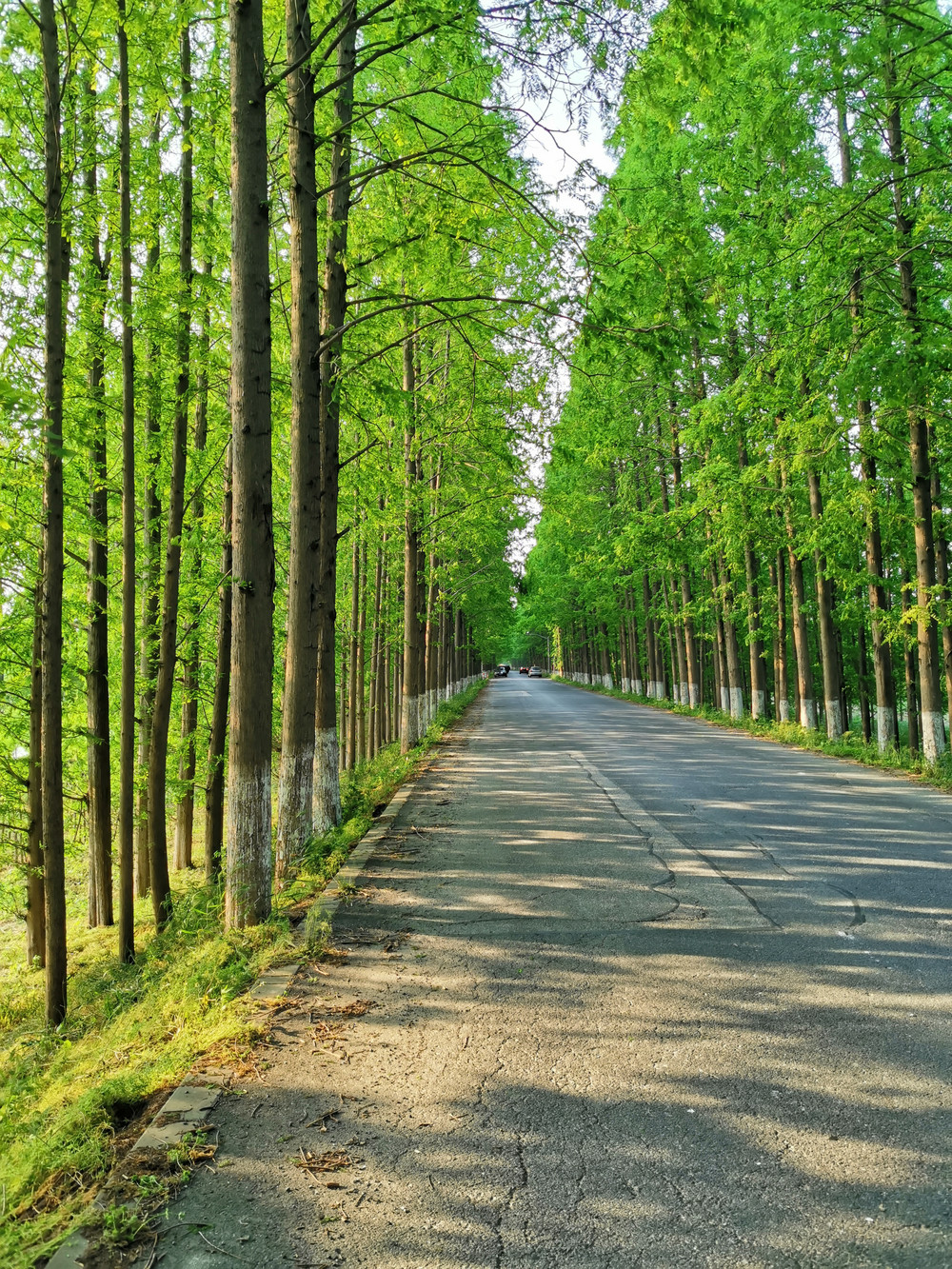
As you approach the intersection of Dongda Highway and Tangxia Highway, it’s worth disembarking and proceeding southward along Tangxia Highway on foot. Here, you’ll be greeted by the towering and majestic metasequoia forests that flank the highway. On the western side, the Suitang River was a result of the soil excavation during the construction of Renmintang’s inner side and was further reinforced in 1952. This river boasts a navigation capacity of 10-40 tons, adding to the region’s waterway infrastructure.
The metasequoia forest belt on the west side of Tangxia Highway is particularly scenic, thanks to the presence of the Suitang River. This side of the highway boasts a wider and denser forest, with an overgrowth of moss and weeds, creating a wild and natural ambiance. Birds can be seen and heard跳跃 and鸣唱 on the branches, adding to the charm of the area. Many visitors drive from far and wide to camp and rest on the grass within the forest, enjoying the tranquility and beauty of the natural surroundings.
In addition to the natural splendor, Tangxia Highway is also home to several water conservancy facilities, including sluices. One such feature is the abandoned sluice that connects the east and west sides and crosses under Tangxia Highway over Huangjiawa Port River. Built in 1970 and named ‘Huangjiawa Port Sluice’, this sluice primarily serves to regulate the water level of Huangjiawa Port in Renmintang and supports the irrigation needs of the farmland at Donghai Farm.The abandoned water gate, nearly half a century old, now stands as an artifact of historical significance. The words ‘Long live Chairman Mao’, ‘Wishing Chairman Mao a long life’, and ‘Listen to Chairman Mao and follow the Communist Party’ are clearly visible on the cement sluice gate frame.
The path of Tangxia Highway roughly aligns with the landing flight path of Pudong Airport. As one strolls along this highway, the occasional sight of airplanes flying overhead along the tree-lined avenue is accompanied by their roaring sound, echoing with a sense of tranquility akin to the saying, ‘the cicadas’ singing makes the forest even more serene.’
As the sun sets in the west, a walk through the woods reveals the tranquil Sui Tang River and the quiet metasequoia forest, offering a unique natural elegance. This scene is reminiscent of a passage from the ‘Analects of Confucius’: ‘In late spring, when the spring clothes are ready, a group of five or six elders and six or seven children bathe in the Yi River, enjoy the breeze at the Wu Dance Altar, and sing their way back home.’
Related posts:
 One-Day Tour of Shanghai Astronomy Museum – Sheshan Catholic Church – Shanghai Earthquake Museum (The Most Comprehensive Travel Notes and Strategy)
 One-Day Team Building in Shanghai??Strawberry Picking
 Autumn Cruise with Parents: Embracing the Ocean Spectrum
 2022 Spring Festival Self-driving Tour in Shanghai (Longhua Temple, Yongding Temple, Huilong Temple, Xinchang Ancient Town, Sanlintang Old Street, Lujiazui Binjiang)
 2023 Mid-Autumn Team Building Event Venue Recommendations: Join Le Huo Pang Pang at Le Huo Camp
 7-Day Self-Driving Tour: Shanghai – Tiantai – Linhai – Taizhou – Shi Tang – Xinchang – Shanghai