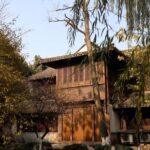
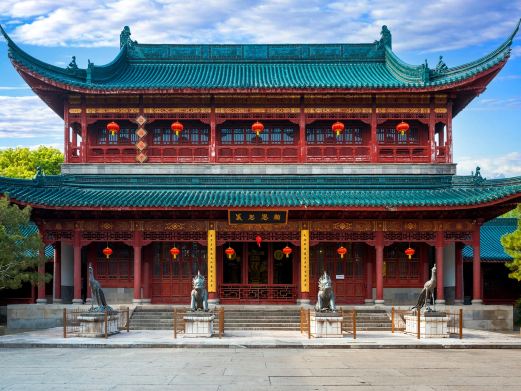
Jixi Renli is a typical ancient Huizhou village. So far, a large number of buildings from the Yuan, Ming and Qing dynasties are still preserved in the village. Jixi Renli is adjacent to mountains and rivers, with profound cultural accumulation. It is truly the ‘hometown of Cheng and Zhu’ in ancient Huizhou. Historically, Jixi Renli was a water and land wharf where Huizhou merchants gathered. It accumulated wealth and vitality.
There were thousands of households and countless stoves. There is a saying that ‘Jixi county is small, but Renli village is large’. It is an important town on the ancient Huizhou-Hangzhou road. In the village, there are historical remains such as ancient city gates, ancient ancestral halls, ancient memorial archways, ancient dwellings, ancient academies, ancient docks, ancient peach blossom dams, and ancient wells. This fully shows the image of Jixi Renli village as an important commercial town in Huizhou history. At the same time, Renli is also a place favored by the minister of works. Renli was originally the birthplace of the Geng family in Jixi. According to the Genealogy of the Geng Family in Yuchuan, in the fifth year of Datong in the Liang Dynasty of the Southern Dynasties (539), Geng Yuanjin, the minister of works, and Geng Rujin, the great general who assisted the country and protected the heaven (who had served as the prefect of Hangzhou), admired the landscapes of Xin’an on their journey back home in full dress. In Renli, Liang’an (Jixi), seeing the surrounding mountains and waters and beautiful scenery, they did not hesitate to abandon their native places and move here. They named the village ‘Renli’. Later, this place became a village inhabited by the Cheng family, so it was also called Chengli. Due to the rapid population expansion, it was renamed Darenli in the late Ming and early Qing dynasties. The Cheng family in Renli originated from Huangdun, Shexian. The first ancestor is Yaogong, named Yao Yi, with the courtesy name Dongsheng. He is the eighteenth generation grandson of Duke Cheng Zhongzhuang. In the first year of Guanghua in the Tang Dynasty (898), he was recommended as the magistrate of Jinxiang County. Because he admired the beautiful landscapes in Renli area, he moved his family here to settle down. Before the Cultural Revolution, there were more than ten stone archways in the village, mostly chastity archways. Now there are two remaining. Among them, the Huangmengong Archway is eye-catching (existing remains). It is said that this archway was erected for a villager who served as a minister in the imperial court (an official serving by the emperor). There is also a tomb passage archway for the first ancestor of the Cheng family in the village. The horizontal inscription is engraved with ‘Tomb Passage of Yaogong, Magistrate of Jinxiang County in the Tang Dynasty’. This is a tomb passage archway with complete inscriptions remaining in Jixi, and it is also the archway with the longest history. Opening hours: Open all year round from 07:30 to 17:30. Preferential policies: Children: Free for those under 6 years old (inclusive) or under 1.2 meters in height (inclusive); Discounted for minors aged 6 (exclusive) to 18 years old (with valid certificates). Elderly: Free for those aged 65 years old (inclusive) and above (with ID card and senior citizen card); Discounted for those aged 60 (inclusive) to 65 years old (exclusive) (with ID card and senior citizen card). Students: Discounted for full-time undergraduate and below students. Supplementary note: The above information is for reference only. The specific information is subject to the disclosure on the day at the scenic spot.Thousand-Year Renli
Jixi Renli is a typical ancient Huizhou village. So far, a large number of buildings from the Yuan, [...]