Duration: 2 Days Activity: Free Travel
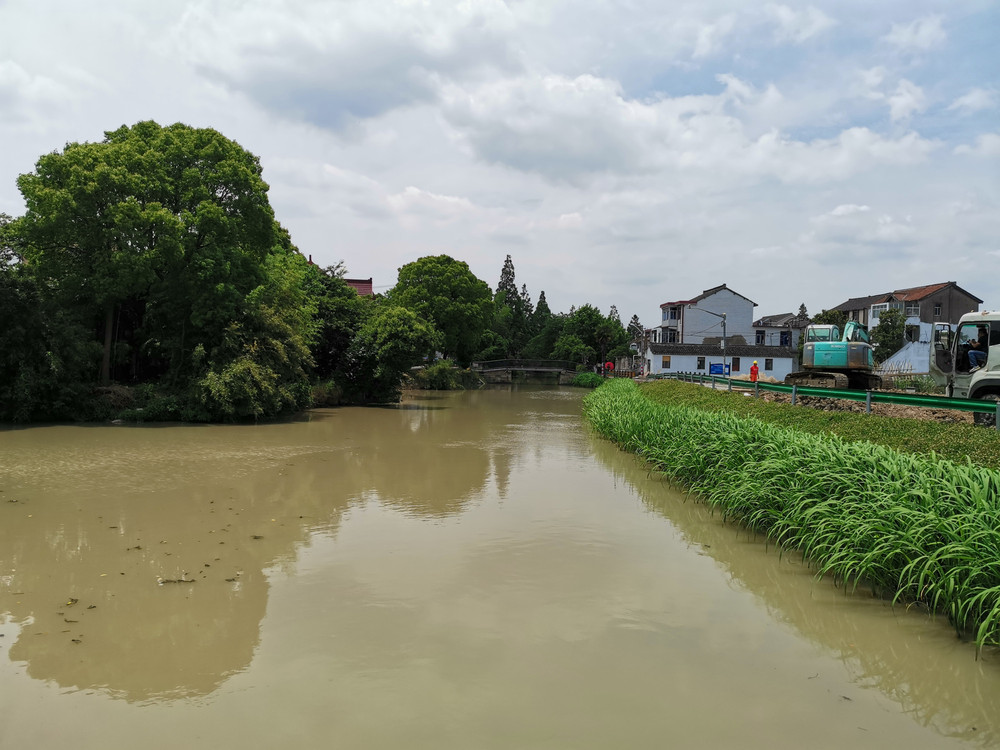
On May 26, 2020, at 20:55 PM, the author published an account of a leisurely exploration of historic stone bridges in Shanghai. The visit took place over two days, with the author seizing a free afternoon to stroll and discover these architectural gems.
**Day 1: Discovery and Initial Exploration**
During a warm early summer day, on May 22, 2020, the author took advantage of a lunch break to visit four stone bridges built during the Republic of China era. These bridges are located near Gu Tang Road and Huadong Road in Tangzhen, Pudong, Shanghai. Upon arriving at the intersection of Gu Tang Road and Tang Long Road by car, the author’s attention was immediately drawn to Zhenghe Bridge, which spans the Shensha Port to the west of Gu Tang Road. Not far to the north, within 200 meters, stood the Rainbow Bridge.
**Rainbow Bridge: A Poetic Landmark**
The Rainbow Bridge, a single-span, double-segment stone beam bridge, is situated to the west of Gu Tang Road, arching over a small river known as ‘Sanlinpu’. This ancient river channel flows westward from a small bay on the old Hu Tang to the Huangpu River. The eastern section is named Sanlinpu, while the wider western section is called Sanlintang. In 1977, the Chuanyang River’s construction divided Sanlinpu into two parts, north and south of the Chuanyang River.
**Historical Context of Pudong’s Waterways**
Rivers in Pudong’s rural areas often bear names such as ‘pu’, ‘tang’, and ‘gang’. Pudong’s flat terrain, formed by the sedimentation of river and sea silt, varies in elevation. The low-lying areas, with severe silt accumulation, suffer from poor drainage and frequent floods. To combat this, an artificial drainage system known as ‘horizontal ponds and vertical ponds’ was excavated, creating a dense network of waterways. The north-south artificial rivers are called ‘pu’, and the east-west ones are called ‘tang’, following a pattern of ‘one vertical pu every five or seven miles, and one horizontal tang every seven or ten miles’. This system facilitated gentle water flow, aiding in storage, irrigation, drainage, and inter-zone transportation.
**The Decline of Ancient Rivers**
In the early Ming Dynasty, Gu Yu penned a bamboo branch poem that highlighted the benefits of these rivers for both merchants and farmers. However, most of these ancient rivers, including Sanlinpu and Sanlintang, have now dwindled to small field rivers. The Rainbow Bridge’s name and patterns are still visible on the bridge stone, with fine craftsmanship evident in the bridge couplet stones. Despite the bridge stones’ thickness, which may have caused the bridge to appear slightly sunken, the bridge seat shows signs of collapse, indicating a dangerous structure.
**Bridge Couplets and Their Meaning**
The bridge couplet on the Rainbow Bridge’s seat is partially submerged, with only four characters visible above water. The phrases ‘Poem Writing Stops the Horse’ to the north on the east side and ‘Taking Shoes and Giving Gold’ to the south suggest an allusion rather than an idiom. The former likely refers to Meng Jiao’s ‘After Passing the Exam’, while the latter seems to allude to Huang Shi Gong Yi receiving Zhang Liang’s military books on a bridge. The couplet’s intention is to inspire local children to study diligently and achieve success.
**Zhenghe Bridge: A Neighboring Structure**
South of the Rainbow Bridge, along a country path, lies Zhenghe Bridge. Like the Rainbow Bridge, it is a single-span stone slab bridge with a slope, but it is wider, consisting of three slabs, and spans the Shensha Port with its northern end located behind Sun’s residence in Tangsi Village.
**The Enigma of the Rainbow Bridge’s Age**
Despite the Rainbow Bridge’s lack of documented construction history, its appearance suggests it was built during the Republic of China era. Though not ancient, it has withstood the test of time for several decades, standing as a testament to the era’s engineering prowess.In the Pudong New Area of Shanghai, the Zhenghe Bridge stands as a protected cultural heritage site, a distinction not shared by the Rainbow Bridge. As documented in Huang Yanpei’s “Chuansha County Chronicles” from the Republic of China era, Zhenghe Bridge was constructed in 1934 at a cost of over 560 yuan, with contributions from notable figures such as Zhang Jiayu, Sun Dabenh, and Huang Hexiang. Geographically, both the Rainbow Bridge and Zhenghe Bridge are situated along the same north-south rural road, suggesting they were built around the same time, nearly eighty-six years ago. These venerable stone bridges now stand as a testament to a bygone era.
The once bustling rural road has transformed into a narrow path, and the Rainbow Bridge has become an almost abandoned agricultural bridge with few pedestrians. In contrast, Zhenghe Bridge, serving as a village bridge, remains a bustling thoroughfare. Heading east from Zhenghe Bridge towards Gutang Road, one notices that the road has filled in the Shensha Port, dividing an ancient east-west river into two parts, a rather crude approach. Ideally, a bridge should have been constructed over the road. South of this point, the Shensha Port Bridge spans Gutang Road, but curiously, there is no river on either side, only the structure itself, raising questions about its placement.
Upon reaching Innovation Middle Road Station on Shanghai Metro Line 2, one might attempt to exit through Exit 4 to visit the nearby Taoqi Bridge, only to find that it is not in use despite being shown on the map. Exiting through another route and circling around to a small river named Nanxingou, one encounters the Taoqi Bridge, a single-arch stone slab bridge. Built in 1929, it was funded by Tao Rangqing, a benevolent and public-spirited figure in the Chuansha area during the Republic of China era. This bridge was the seventh one he funded. Beside the bridge’s name on the stone slab, there is an inscription with ’18th year of the Republic of China’ and the names of Tao Rangqing and two other bridge builders. After ninety years of weathering, the inscriptions have become somewhat illegible, but the name ‘Taoqi Bridge’ remains clear.
In ancient times, funding bridge and road construction was considered a great virtue, and many local gentry, merchants, and officials were willing to do so for the benefit of their hometowns. This tradition of benefiting the community and leaving a lasting legacy continued into the Republic of China era but sadly is no longer practiced today. A small section of neatly stacked bluestone revetment and two granite mooring stones on the west side of the Taoqi Bridge’s northern abutment evoke images of ships docking at the bridge and the bustling water and land traffic of yesteryear. Today, Nanxingou has become an ordinary residential river in front of Fei’s residence in Tangzhen Jikou Village.
Over a thousand meters south of Taoqi Bridge, there is another single-span stone beam bridge named ‘Public Welfare Eleventh Bridge’. Gaode Map shows a country path leading to it, but upon visiting the site, it is found to be blocked by construction walls around the bridge and road works. From Yu Pu Tao Bridge on Huadong Road, Public Welfare Eleventh Bridge is not far away. I intended to get closer to inspect the bridge, but with almost no path leading to the stone bridge and time constraints, I could only leave it for a future visit. With this unfulfilled wish in mind, on the afternoon of May 26th, amidst the drizzle, I revisited Public Welfare Eleventh Bridge.
Duration: 2 days. Play style: Independent travel. The author visited these places: Shanghai Huangpu River. Posted on May 26, 2020 at 20:55. During lunch break, I took a stroll at leisure. I accidentally learned that there are four stone bridges built in the period of the Republic of China near Gutang Road and Huadong Road in Tangzhen, Pudong, Shanghai. Although the weather is a bit hot in early summer, on May 22, 2020, I specially went to visit and explore during lunch break. After arriving at Tanglong Road on Gutang Road by bus, as soon as I got off the bus, I saw Zhenhe Bridge spanning Shensha Port from north to south not far to the west of Gutang Road. There is also Caihong Bridge about 200 meters to the north. I continued to walk north along Gutang Road and first went to see Caihong Bridge. Caihong Bridge, with a poetic bridge name, is a single-span double-stone beam bridge. It is located on the west side of Gutang Road and spans a small river named ‘Sanlinpu’ from north to south. Sanlinpu is an ancient river course that flows west from Xiaowan on the old seawall to the HuangpuMost of the rivers in the countryside of Pudong are named after pu, tang, and gang. Pudong is formed by the alluvial deposits of river and sea sediments. Although the terrain is gentle, there are still high and low areas. The low-lying areas have serious sedimentation, resulting in poor drainage and prone to floods. In ancient times, in order to obtain flat salt fields and paddy fields that were not afraid of floods, an artificial irrigation and drainage system of ‘horizontal tangs and vertical pus’ was excavated to form a dense water network. Among them, the artificially excavated north-south longitudinal rivers are called ‘pu’, and the east-west horizontal ones are called ‘tang’. ‘One vertical pu every five or seven li, one horizontal tang every seven or ten li’. The ‘vertical’ and ‘horizontal’ are interconnected. The ‘horizontal tangs and vertical pus’ make the water flow gentle and facilitate storage, irrigation, drainage and inter-regional transportation. In addition to Sanlin Tang, Yantie Tang, Shenzhuang Tang, and Zhoupu Tang, there are also eighteen east-west Zaomen Gangs. ‘One tide connects a hundred ports’, and finally leads to the sea through the Huangpu River. In the early Ming Dynasty, Gu Yu had a bamboo branch poem: ‘The tide flows through the branch ports and the evening tide is flat. Merchants can sail and farmers can cultivate.’ These crisscrossing meandering rivers on the land of Pudong once benefited generations of Pudong villagers. Unfortunately, now whether it is Sanlinpu, Sanlin Tang, or other ancient rivers in Pudong, most of them have become small rivers in the fields.
The bridge name ‘Caihong Bridge’ engraved on the bridge stone of Caihong Bridge and the patterns at both ends are still relatively clear. There are also bridge couplet stones on the bridge abutment, with fine workmanship. The two bridge stones of Caihong Bridge are very thick. Perhaps because the bridge stones are too heavy, the stone bridge feels a bit sunken. The bridge abutment has also collapsed to some extent, and there is a risk of becoming a dangerous bridge. Only four characters above the water surface can be seen on the bridge couplet of Caihong Bridge abutment. Among them, on the east side, the north of the bridge couplet is ‘Write Poems and Stop Horses’, and the south is ‘Accept Shoes and Give Gold’. There should be three characters under the water to form a complete couplet. It is also possible that the bridge couplet is simply a four-character combination. From the aforementioned couplet, it is evident that it is not an idiom but rather a reference, albeit with seemingly imprecise wording. ‘Inscribed poetry halting chariots’ likely references the Tang Dynasty poet Meng Jiao’s seven-character quatrain ‘After Passing the Imperial Examinations’ with the lines ‘With the spring breeze in my favor, my horse’s hooves are swift, seeing all the blossoms in Chang’an in a single day.’ Meanwhile, ‘Receiving shoes and bestowing gold’ probably refers to the story of Huang Shi Gong bestowing military books to Zhang Liang on the bridge, but it should be ‘bestowing books’ rather than ‘bestowing gold.’ In terms of meaning, the bridge couplet on the Rainbow Bridge seems to encourage local youth to study diligently and achieve academic success. On the west side of the Rainbow Bridge, there is also a bridge couplet, but due to the small miscellaneous trees growing in the cracks of the bridge stones, the inscriptions are not visible. There is no available written material regarding the Rainbow Bridge, so its exact construction date is unknown. Judging by its appearance, it seems to be a building from the Republic of China era and cannot be considered an ancient bridge, yet it has also withstood decades of vicissitudes.
Leaving the Rainbow Bridge and heading south along the rural path, one arrives at the Zhenghe Bridge. Like the Rainbow Bridge, the Zhenghe Bridge is a single-span inclined stone slab bridge, but it is wider, composed of three slabs, spanning the Shensha Port from north to south, with the northern end located behind the residence of the Sun family in Tangsi Village. Unlike the Rainbow Bridge, the Zhenghe Bridge is a protected cultural heritage site in Pudong New Area and is recorded in Huang Yanpei’s Republic of China era ‘Chuansha County Annals’: constructed in the twenty-third year of the Republic of China (1934), with a construction cost of over five hundred and sixty yuan, and funded by Zhang Jiayu, Sun Daiben, Huang Hexiang, and others. From the direction, the Rainbow Bridge and Zhenghe Bridge are on the same north-south rural road, and they should have been built around the same period, nearly eighty-six years ago, making them old stone bridges. Of course, the rural road that has been in use forLeaving the Zhenghe Bridge and heading east back to Gutang Road, one finds that the road has filled in the river and cut off Shensha Port, splitting an ancient east-west river into two parts, which seems a bit crude. It would have been better to build a bridge over the road. Not far south, there is a road bridge on Gutang Road named Shensha Port Bridge, but there is no river on either side of the bridge, just an empty bridge—strange.
Arriving at the Innovation Middle Road Station of Shanghai Metro Line 2, intending to exit from Exit 4 to the nearby Taoqi Bridge, one finds that although the map shows Exit 4, it is actually not in use. Exiting from another exit and walking along a small river called Nanxingou, one encounters the Taoqi Bridge, a single-hole stone slab bridge with a single pier. The Taoqi Bridge spans Nanxingou from north to south and was built in the eighteenth year of the Republic of China (1929 AD). The donor and builder of the Taoqi Bridge, Tao Rangqing, was a benevolent and public-spirited social figure in the Chuansha area during the Republic of China era, and this bridge is naturally the seventh one he funded and built. Beside the bridge name ‘Tao Qi Bridge’, carved in stone, is an inscription that reads ‘the 18th year of the Republic of China’ along with the names of three bridge builders, Tao Rangqing among them. After ninety years of erosion from wind and rain, the inscriptions have become somewhat blurred, yet the name ‘Tao Qi Bridge’ remains clear. In ancient times, funding the construction of bridges and roads was considered a benevolent act of infinite merit, and many esteemed gentry, wealthy merchants, and officials were willing to undertake such tasks for the benefit of their hometowns. This tradition of benefiting the local community and leaving a legacy for future generations continued into the Republic of China era, but sadly, it is no longer practiced today. On the west side of the northern abutment of Tao Qi Bridge, a small section of neatly stacked bluestone retaining wall remains, along with two granite mooring stones, which allows one to imagine the bustling scene of boats docking at the bridge and the busy water and land traffic of the past. Now, the Nanxin Canal has become an ordinary residential river in front of Fei’s residence in Jikou Village, Tangzhen.
More than a thousand meters south of Tao Qi Bridge, there is a single-span stone beam bridge named ‘Gongji Eleventh Bridge’. Gaode Map shows a rural path leading to Gongji Eleventh Bridge, but upon reaching the site, it is found to be blocked by a construction site wall. Looking west from Yu Pu Tao Bridge on Huadong Road, Gongji Eleventh Bridge is not far away. Initially, I wanted to approach and inspect this bridge, but seeing that there were almost no paths leading to the stone bridge, and due to time constraints, I could only leave it for a future visit. With an unfulfilled wish in mind, on the afternoon of May 26th, amidst the drizzle, I revisited Gongji Eleventh Bridge. Walking through the muddy fields after the rain, I arrived at the bridge. As the name suggests, Gongji Eleventh Bridge was the eleventh bridge built under the supervision of the Gongji Bridge Association in the Chuansha area during the Republic of China period. According to the records in the ‘Chuansha County Annals’ from the Republic of China, Gongji Eleventh Bridge was constructed in the 22nd year of the Republic of China (1933 AD), with a construction cost of 500 yuan, donated by the Gongji Bridge Association with 250 yuan, and the rest raised by Lu Wenmei. The small river under the bridge, named Yu Pu Tao, has a somewhat peculiar name, perhaps it should be ‘Yu Pu’. Gongji Eleventh Bridge has the bridge name and patterns carved on its stone, with the name ‘Gongji Eleventh Bridge’. It appears that Gongji Eleventh Bridge has never been renovated and has essentially maintained its appearance from decades ago. Judging from the current surrounding conditions, Gongji Eleventh Bridge has become an abandoned bridge. Geographically, this bridge forms a straight line with Tao Qi Bridge from north to south, and even with the Zhenghe Bridge and Rainbow Bridge I visited earlier, it might have once been connected by the same rural road, but now this road has long been obliterated and isolated. Originally, there were farmhouses north of Gongji Eleventh Bridge, but they are now vacant with the word ‘demolish’ written on the walls, and several nearby farmhouses are in the process of being demolished. The small vegetable gardens in front of the farmhouses along the river still have seedlings, indicating that the farmers have not left long ago. It isThe rainbow lies across the clear waves, and the bridge stones have withstood the vicissitudes of time; the scenery of ancient stone bridges always makes me stop in my tracks. The four stone bridges in Tangzhen that I visited are of the same structure, all single-span stone arch bridges with piled pier stones. Their construction dates are also close to each other, marking the final period of Chinese stone bridge architecture.
Eighty to ninety years have passed in a hurry, and although these four stone bridges are not ancient, they have also begun to show signs of aging. Some, like the Rainbow Bridge, have become nearly perilous due to lack of maintenance; others, like Zhenghe Bridge and Taoqi Bridge, have been repaired in previous years; and some, like the Eleventh Gongji Bridge, have gradually become abandoned. These stone bridges have different fates, but they have all once facilitated the coming and going of travelers, embodying the heartfelt dedication of their builders.
They have withstood the test of time, witnessing the changes in human affairs, and are not only natural landscapes but also traces of human culture. Standing by the bridge, strolling on it, one can enjoy the clouds rolling and relaxing across the sky, suitable for both sunny and rainy weather. Watching the water flow gently, feeling the breeze on one’s face, discerning the gradually weathered inscriptions and patterns on the mottled bridge stones, one cannot help but sigh at the fleeting nature of life while the bridge stones endure.
How many events from ancient and modern times, how many people have come and gone, who at this moment would lean on the railing with intent?
Related posts:
 Shanghai’s Historical and Cultural Origin – Comprehensive Travel Guide to Songjiang District
 Shanghai’s Niche Ways to Play: Visiting the Most Artistic Private Museum
 Searching for the ‘Root’ in Shanghai: The Popular Songjiang District
 2-Day Self-Driving Tour of Qingpu, Shanghai (Zhujiajiao Ancient Town, Qu Shui Garden, Qingxi Garden, and Fuquan Mountain Site)
 Where I’m From – Part 7
 Visit Yangzhou for an Unforgettable Culinary Experience!